
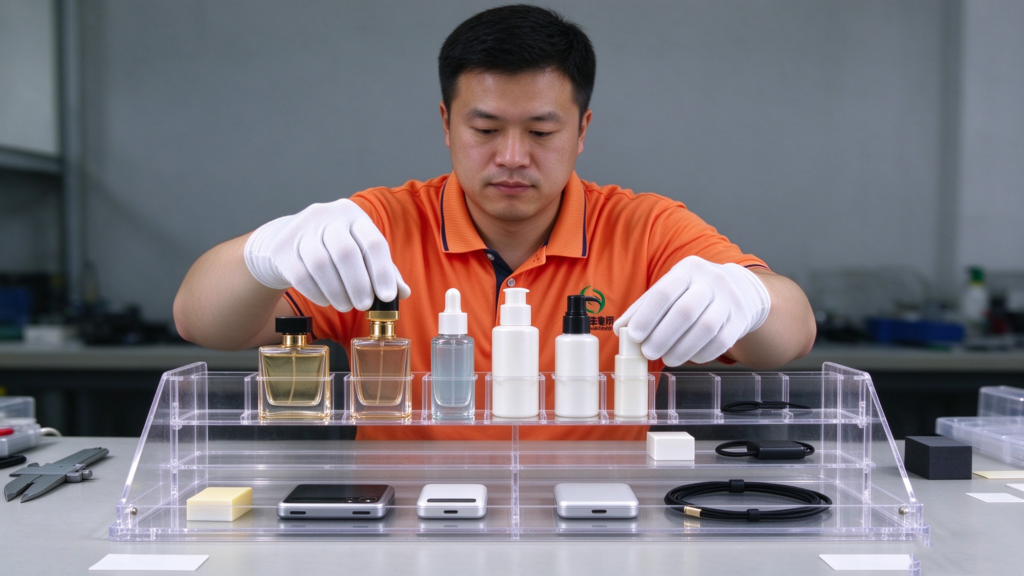
You receive your custom acrylic displays, unpack the shipment, and start placing your products inside. Then you discover that the compartments are too narrow, the products sit too tightly, or the packaging will not fit at all.
The display looks exactly like the approved drawing. Unfortunately, the drawing was based on the wrong measurements.
For buyers ordering custom displays, custom display dimensions are not just numbers on a technical drawing. They determine whether your products fit, whether customers can remove them easily, and whether the finished display works as intended in a real retail environment.
The good news is that many fit problems can be prevented before production. Here is what to check when preparing your next custom display order.
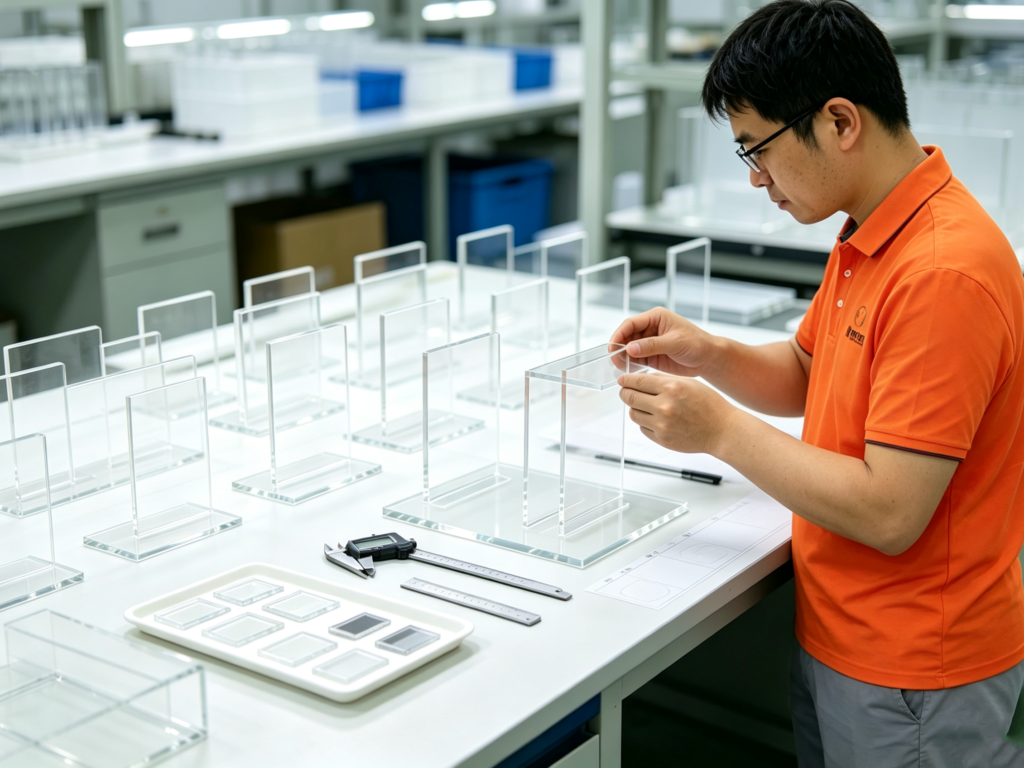
1. Measure the Actual Product, Not Just the Product Listing
One of the easiest mistakes is using dimensions from an online product page or an early specification sheet without checking the actual product.
Published dimensions may be rounded. Packaging may change during development, and different product variants may have slightly different sizes.
Before approving a display design, measure the actual product whenever possible.
Record the following:
Length, width, and height.
The widest and tallest points, including protruding parts.
The dimensions of caps, handles, closures, or other components.
The weight of each product.
Any irregular shapes that could affect how the product sits in the display.
For products with curved surfaces, tapered bodies, or unusual shapes, three overall measurements may not be enough. You may need to identify the specific contact points or areas that the display will support.
If you are ordering displays for several products, provide the measurements for each variant rather than assuming they are identical.
Buyer tip: Send photographs alongside the measurements. A photo showing the product from the front, side, and top can help the manufacturer understand details that numbers alone may not communicate.
2. Decide Whether the Display Must Fit the Product or Its Packaging
This is a crucial decision that should be made before the design is finalized.
A product and its retail packaging can have very different dimensions. A bottle may fit comfortably in a display while its carton does not. Conversely, a display designed for a box may leave the unpackaged product poorly supported.
Consider a cosmetics brand launching a new serum. The bottle dimensions remain unchanged, but the packaging team adds a thicker carton with a new protective insert. If the display was designed around the original carton, the revised packaging may no longer fit.
Before confirming the design, answer these questions:
Will customers see the product inside its retail packaging?
Will the product be displayed without packaging?
Will the display hold both packaged and unpackaged products?
Are there multiple package sizes?
Is the packaging design final?
If packaging is still being revised, tell your manufacturer which dimensions are confirmed and which are provisional.
It is much easier to adjust a design before production than to discover that the finished display cannot accommodate the final product.
3. Leave Enough Clearance for Easy Product Access
A product fitting inside a compartment does not automatically mean the compartment is designed correctly.
If the opening is too tight, staff may struggle to restock the display, and customers may find it difficult to remove products. If it is too loose, the products may lean, move around, or look poorly arranged.
The required clearance depends on the product shape, the display structure, and how the product will be inserted and removed.
When reviewing your design, consider:
How much space is needed to insert the product?
Can customers grip the product without touching neighboring items?
Will the product move when the display is handled?
Does the compartment need to accommodate packaging variations?
Will staff need to remove products frequently for restocking?
There is no single clearance measurement that works for every display. A close-fitting slot for a flat product requires a different approach from a compartment holding a rounded bottle or a boxed item.
For a custom acrylic display, ask the manufacturer to confirm the intended fit rather than assuming that matching the product’s exact dimensions will be sufficient.
4. Check Acrylic Thickness and Internal Dimensions
A common source of confusion is the difference between a display’s external dimensions and its usable internal space.
Imagine a display with an external width of 300 mm. That does not mean the available space inside is also 300 mm.
Side panels, dividers, back panels, and other structural components occupy space. Depending on the design, these components may reduce the usable width or depth of individual compartments.
When reviewing a drawing, distinguish between:
Overall dimensions: The display’s external length, width, and height.
Internal dimensions: The usable space inside the display.
Opening dimensions: The size of the opening through which products are inserted or removed.
Clearance: The additional space needed for fitting, handling, and normal use.
Acrylic thickness also affects the final dimensions. If a compartment is formed between two panels, the panel thickness and joint arrangement must be considered when calculating the usable space.
For more information about material selection, read our article on Acrylic Thickness for Display Stands. Confirm the URL before publishing.
5. Consider Manufacturing Tolerances
Even when a drawing specifies exact dimensions, manufactured parts can vary slightly within the agreed tolerances.
This matters most when several components must fit together or when products sit inside closely sized openings.
For example, a display may contain multiple slots intended to hold products of nearly identical dimensions. If the design leaves very little clearance, small variations in the product or the finished display could make insertion difficult.
Before production, discuss the following with your manufacturer:
Which dimensions are critical to product fit?
What tolerances are appropriate for those dimensions?
Which dimensions are measured externally and internally?
How will the finished display be checked?
Are the actual products or packaging available for a fit check?
The required tolerances depend on the design, materials, manufacturing processes, and intended use. Avoid specifying extremely tight tolerances everywhere without a clear reason, as this may increase manufacturing complexity and cost.
Instead, identify the dimensions that directly affect functionality and agree on suitable acceptance criteria for those features.
6. Check the Full Product Layout, Not Just One Compartment
A display may fit one product perfectly and still fail to accommodate the complete product range.
This can happen when several items share a display, when the number of products increases, or when the arrangement changes during the design process.
Before approving the layout, check:
The number of products displayed in each row.
The spacing between neighboring products.
The total width and depth required by all products.
Whether labels and logos remain visible.
Whether customers can reach products at the back.
Whether the display fits within the available retail space.
For example, if a display is designed for six product boxes, adding a seventh box may require changes to the compartment spacing or overall width.
Do not rely only on a front-view drawing. Review the top, side, and front views, and consider a three-dimensional rendering when the structure is complex.
If you have multiple product sizes, make sure the final drawing clearly identifies where each variant belongs.
7. Verify the Design Before Mass Production
A drawing review is essential, but some fit problems are easier to identify with a physical sample.
If the display has complex compartments, unusual product shapes, or tight fitting requirements, consider testing a sample using the actual products and packaging.
During the fit check, confirm:
Every product fits in its intended position.
Products can be inserted and removed without excessive force.
The display does not obstruct important product labels.
The arrangement looks balanced when fully loaded.
The display remains stable during normal use.
The actual dimensions match the agreed specifications.
If a sample is not practical for your project, ask the manufacturer what alternative verification methods are available. The right approach depends on the complexity and risk of the design.
Once the sample or final drawing is approved, keep a record of the approved version. If your product dimensions change afterward, notify the manufacturer before production continues.
A small revision to the product can affect multiple display components, so changes should be reviewed rather than assumed to be harmless.

What to Send Your Display Manufacturer
You do not need a perfect engineering drawing to begin a discussion with a custom display manufacturer. However, the more reliable information you provide, the easier it is to evaluate the design.
Prepare the following where available:
Product photographs from multiple angles.
Product dimensions and weight.
Final packaging dimensions, if the product will be displayed in its box.
The required number of products per display.
Reference images or sketches of your preferred layout.
The maximum display dimensions allowed by the retailer.
Any special requirements for product access, stability, or branding.
If some details are not final, label them clearly as preliminary. This allows the manufacturer to work on the general concept without treating unconfirmed measurements as production-ready specifications.
How MORICH Helps Prevent Display Fit Problems
MORICH manufactures custom finished acrylic displays for businesses that need product-specific layouts, dimensions, and branding.
Depending on the project, our capabilities include design coordination, CNC machining, laser cutting, edge polishing, printing, and assembly.
For a new display project, share your product measurements, photos, packaging details, and desired product arrangement. If your product is still being developed, explain which dimensions may change so those details can be considered during design.
The goal is to develop a display that works with your actual products, rather than simply reproducing a drawing that looks correct on screen.
Explore our custom acrylic commercial displays or visit our manufacturing capabilities page to learn more about our services. Verify these page URLs before publishing.
Frequently Asked Questions
What measurements do I need for a custom acrylic display?
Start with the product’s length, width, height, and weight. Also provide the dimensions of its packaging, if applicable, along with the number of products to be displayed and any restrictions on the overall display size.
Should a display compartment have exactly the same dimensions as the product?
Usually, the fit needs to account for clearance, product shape, manufacturing tolerances, and how the item will be inserted or removed. The appropriate dimensions depend on the specific application.
Why does my product not fit a display even though the drawing looks correct?
Possible causes include incorrect product measurements, changes to the packaging, confusion between internal and external dimensions, insufficient clearance, or manufacturing variation. Compare the finished display with the approved specifications to identify the issue.
Should I send physical products to the manufacturer?
A physical sample can be helpful when product shape, fit, or handling is difficult to communicate through drawings alone. Discuss the arrangement with your manufacturer and confirm whether a physical sample is necessary for your project.
Can I change my product packaging after the display design is approved?
You can, but the change should be reviewed before production. Even a small increase in package width or height may affect compartment dimensions, product spacing, and the overall layout.
Final Thoughts
Getting custom display dimensions right requires more than measuring a product once. You need to account for packaging, usable internal space, product clearance, manufacturing tolerances, and the complete product layout.
The most effective way to prevent fit problems is to share accurate measurements early, identify any details that may change, and verify the design against the actual product before committing to mass production.
Planning a custom acrylic display? Send MORICH your product photos, dimensions, packaging details, and reference ideas to discuss a suitable design.