
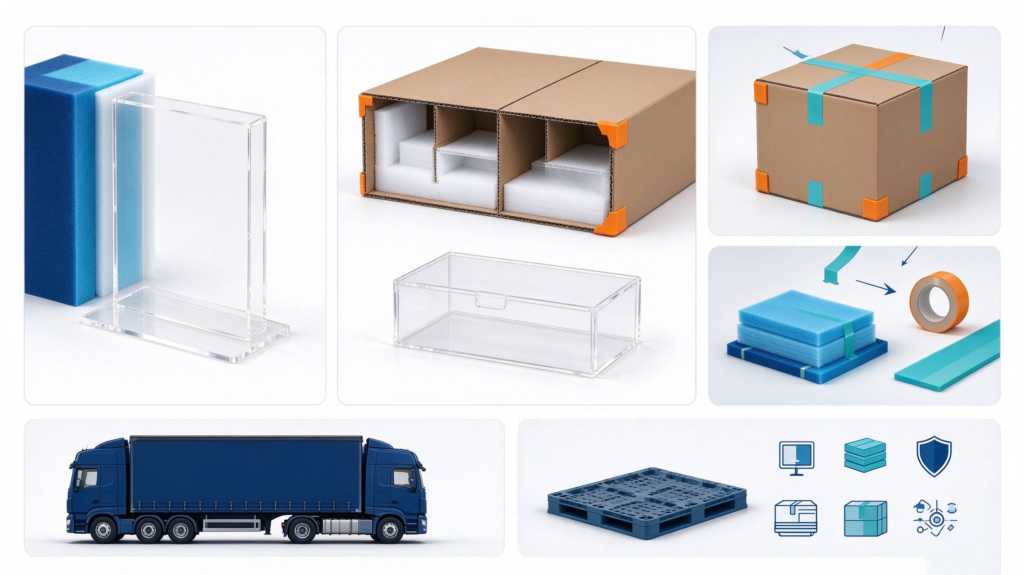
Custom packaging for acrylic products is essential when shipping displays, organizers, boxes, and other finished acrylic items overseas. Although acrylic products are lightweight and visually appealing, their polished surfaces, corners, joints, and decorative finishes can be damaged by friction, impact, or pressure during long-distance transportation.
For an acrylic factory, preparing products for sea freight involves more than choosing a carton and adding cushioning. The packaging must match the product’s structure, shipping conditions, loading method, and destination requirements.
Here is how a professional acrylic manufacturer can develop a suitable packaging solution for international orders.
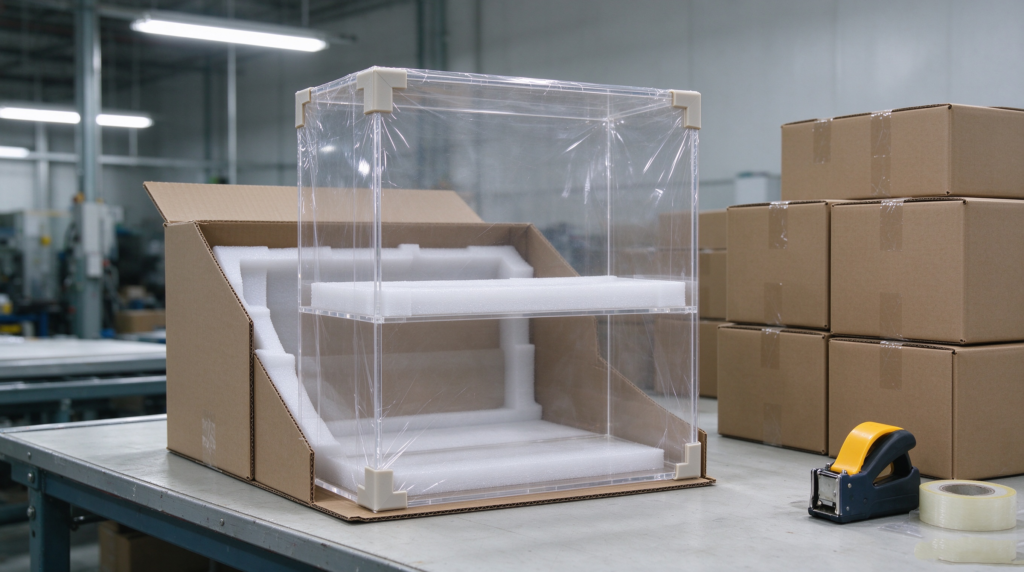
Why Acrylic Products Need Custom Packaging
Acrylic products come in many shapes and structures. A flat acrylic panel, a transparent storage box, and a multi-tier display stand have different packaging requirements.
Common risks during overseas transportation include:
Surface scratches: Acrylic panels may rub against each other or against packaging materials.
Broken corners and edges: Exposed edges can be vulnerable to impacts during handling.
Pressure damage: Heavy cartons stacked above a package may place pressure on vulnerable components.
Movement inside cartons: Poorly secured products may collide during transportation.
Joint damage: Assembled products may experience stress if their structure is not properly supported.
Decorative finish damage: Printed logos, colored surfaces, and other finishes may be scratched or contaminated.
Custom packaging helps address these risks before products leave the factory. The goal is to deliver products in the agreed condition while avoiding unnecessary packaging materials and shipping volume.
1. Design Packaging Around the Acrylic Product
The first step is to understand the product before selecting packaging materials.
An acrylic factory should consider the following details:
Overall dimensions and product weight.
Panel thickness and structural design.
Fragile corners, polished edges, and bonded joints.
Printed logos and decorative surfaces.
Whether the product ships assembled or in separate components.
The number of units packed in each carton.
For example, a clear acrylic display with several shelves may need internal supports to prevent the shelves from pressing against one another. A flat acrylic panel may require full-surface protection and reinforced edge support instead.
Packaging should be designed around the product’s vulnerable areas rather than using the same packing method for every order.
2. Protect Acrylic Surfaces From Scratches
Surface protection is particularly important for transparent acrylic products. Fine scratches can become obvious under retail lighting, even when the product remains structurally usable.
Depending on the material and product design, a factory may use:
Suitable protective film on compatible surfaces.
Soft interleaving materials between separate panels.
Clean protective sleeves or wrapping.
Individual packaging for products with delicate finishes.
Internal dividers to prevent direct contact between units.
Protective materials must be compatible with the acrylic and its surface finish. Some adhesives may leave residue, and certain materials can damage printed or coated surfaces if they remain in contact for too long.
For products with UV-printed logos or decorative finishes, the factory should identify which areas require additional protection.
3. Use Custom Inserts to Prevent Movement
One of the most important packaging decisions is how to keep the product in place.
If an acrylic item moves freely inside a carton, repeated vibration and impact may cause scratches, chipped corners, or damage to bonded components.
A custom insert can help hold the product in a defined position. Depending on the product, possible solutions include:
Foam inserts shaped around vulnerable sections.
Cardboard partitions between individual products.
Molded pulp inserts where suitable.
Custom-cut cushioning for irregular shapes.
Internal supports that prevent shelves or panels from shifting.
The insert should support the product without placing excessive pressure on thin acrylic panels or delicate joints.
For example, a custom acrylic organizer with protruding dividers may need support around its outer structure rather than direct pressure on the dividers themselves.
The best insert is not necessarily the thickest one. It is the one that restrains movement while distributing loads appropriately.
4. Choose the Right Carton and Outer Packaging
Once the product’s internal protection is planned, the factory needs to select suitable outer packaging.
The choice depends on product weight, dimensions, stacking conditions, transport arrangements, and the expected handling environment.
Common options include:
Corrugated cartons: Suitable for many individual acrylic products and smaller shipments when properly specified.
Reinforced cartons: Useful when additional strength or improved handling protection is required.
Partitioned cartons: Help separate multiple units and prevent contact.
Wooden crates or pallets: May be appropriate for large, heavy, unusually shaped, or consolidated shipments, depending on transport requirements.
The carton should provide sufficient space for the protective materials without leaving excessive room for movement. At the same time, it should not be so tight that packing pressure damages the product.
For palletized or consolidated sea freight, the factory should also consider how cartons will be stacked, secured, and handled during loading and unloading.
5. Account for Sea Freight Conditions
Sea freight can involve multiple stages, including factory collection, container loading, port handling, ocean transportation, unloading, and inland delivery.
Packaging must account for the combined effects of handling and transport rather than focusing only on the ocean journey.
Important considerations include:
Vibration and repeated handling
Products should be secured to limit movement inside cartons. Loose components should be separated and restrained.
Stacking pressure
Cartons should be designed and arranged to reduce the risk of excessive loads on vulnerable products. The stacking plan should consider the strength of the outer packaging and the internal support structure.
Moisture and condensation
Temperature changes during transportation can contribute to condensation. The factory should consider the shipping route, packaging materials, and moisture sensitivity of any accompanying components. Moisture-control measures may be appropriate in some cases, but they should be selected for the actual shipment rather than applied automatically.
Container loading
Packaging dimensions affect how efficiently products can be loaded. Carton sizes and pallet arrangements should be considered together with product protection and safe handling requirements.
Destination handling
A shipment may be transferred between different vehicles or warehouses before reaching the buyer. Packaging should be suitable for the planned delivery route, not just the initial factory dispatch.
6. Balance Product Protection and Shipping Cost
Custom packaging should protect the product without unnecessarily increasing freight costs.
Oversized cartons may increase the shipment’s volume, while insufficient packaging may increase the risk of damage and replacement costs.
A professional factory should consider both product protection and packing efficiency.
Useful approaches include:
Optimizing carton dimensions around the product and its protective inserts.
Arranging compatible components together where this does not increase damage risk.
Separating fragile products when individual packing provides better protection.
Evaluating whether products can be shipped disassembled.
Reviewing carton quantities and pallet layouts before production packing begins.
For some custom displays, shipping the product in separate components can reduce package volume. However, this approach only makes sense when assembly is practical and the packaging adequately protects every component.
The best solution is not always the smallest carton. It is the packaging arrangement that provides appropriate protection at a reasonable total shipping cost.
7. Test the Packaging Before Mass Production
A packaging design should be reviewed before it is used for a large shipment, especially when the product is fragile, expensive, or newly developed.
Depending on the project’s risk and shipping requirements, the factory and buyer may consider:
Checking whether the product fits securely inside the package.
Inspecting contact points between the product and protective materials.
Reviewing whether the carton can be handled safely.
Conducting appropriate drop, vibration, or compression tests.
Shipping a trial package when practical.
Inspecting the product after any agreed packaging test.
Testing requirements should match the product and distribution conditions. A simple countertop display may not require the same validation as a large, multi-component retail fixture.
For important export orders, buyers should agree on the packaging standard and acceptance criteria before mass production.
8. Prepare the Packaging Details Before Ordering
Packaging decisions are easier when the factory receives the necessary information early.
When requesting a custom acrylic product, buyers should provide:
Product drawings, dimensions, or reference samples.
Product weight and structural details, where available.
Whether products will be shipped assembled or disassembled.
The required quantity per carton, if specified.
The destination country and delivery address or region.
The planned shipping method, such as sea freight.
Any pallet, labeling, retail packaging, or warehouse requirements.
Special concerns about printed surfaces, corners, or delicate components.
The factory can then evaluate the packaging arrangement alongside the product design.
For custom acrylic displays, discussing packaging early can also reveal design changes that improve shipping efficiency without compromising the product’s appearance or function.
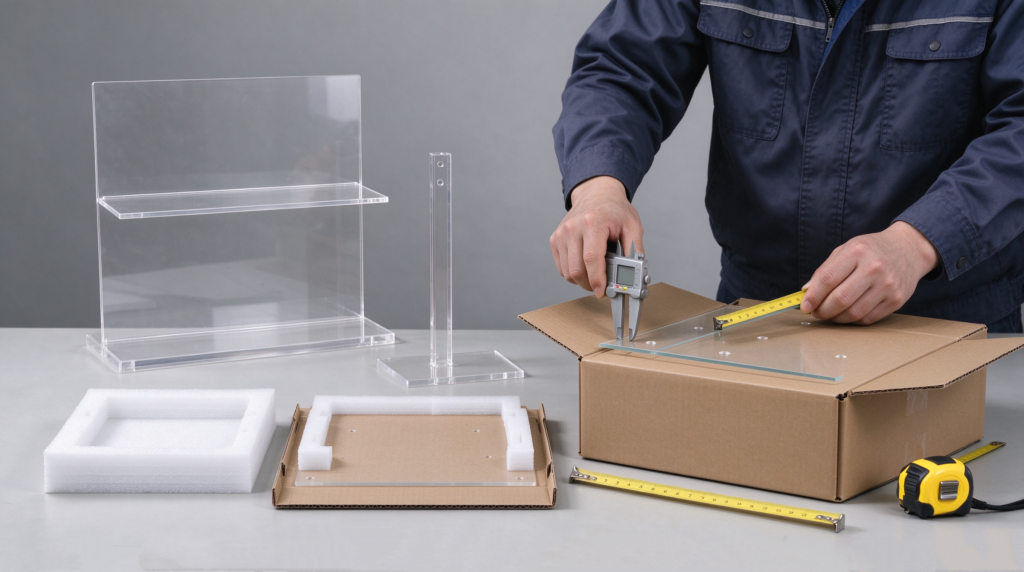
How MORICH Supports Custom Acrylic Product Projects
At MORICH, custom acrylic products can be developed around the buyer’s product requirements, structure, branding, and intended use. Packaging requirements should be discussed as part of the project so that finished products can be prepared for their intended delivery conditions.
When requesting a quotation, buyers can share product drawings, reference images, dimensions, destination information, and sea freight requirements. These details help the team assess the product and discuss suitable packaging options.
Explore our custom acrylic products and manufacturing capabilities, or contact MORICH to discuss a custom project.
Frequently Asked Questions
What is the best packaging for acrylic products shipped by sea?
There is no single best option for every product. The appropriate solution depends on the product’s dimensions, weight, structure, surface finish, and shipping conditions. Protective wrapping, internal dividers, custom inserts, reinforced cartons, or crates may be used as needed.
Should each acrylic product be packed individually?
Individual packing can reduce contact between products and help protect delicate surfaces. However, the most suitable method depends on the product design, shipping risks, and packing efficiency.
Can custom packaging reduce sea freight costs?
Yes, an efficient packaging design may reduce unnecessary carton volume and improve loading arrangements. However, reducing package size should never compromise the protection required for the product.
Does acrylic packaging need moisture protection for sea freight?
It depends on the route, packaging configuration, and sensitivity of the complete product. Condensation can occur during international transportation, so moisture-control measures should be evaluated where appropriate.
Should packaging be tested before a large order?
For fragile or high-value products, reviewing a sample package and conducting suitable tests can help identify weaknesses before shipment. The level of testing should be agreed upon based on the product’s risk and delivery requirements.
Final Thoughts
Custom packaging for acrylic products is an important part of preparing goods for international delivery. A suitable solution combines surface protection, secure internal supports, appropriate outer cartons, efficient packing dimensions, and consideration of sea freight conditions.
For buyers sourcing custom acrylic products, the key is to discuss packaging before production is complete. When the factory understands the product structure and delivery requirements early, it can develop a more practical approach to protecting the finished goods throughout their journey.