
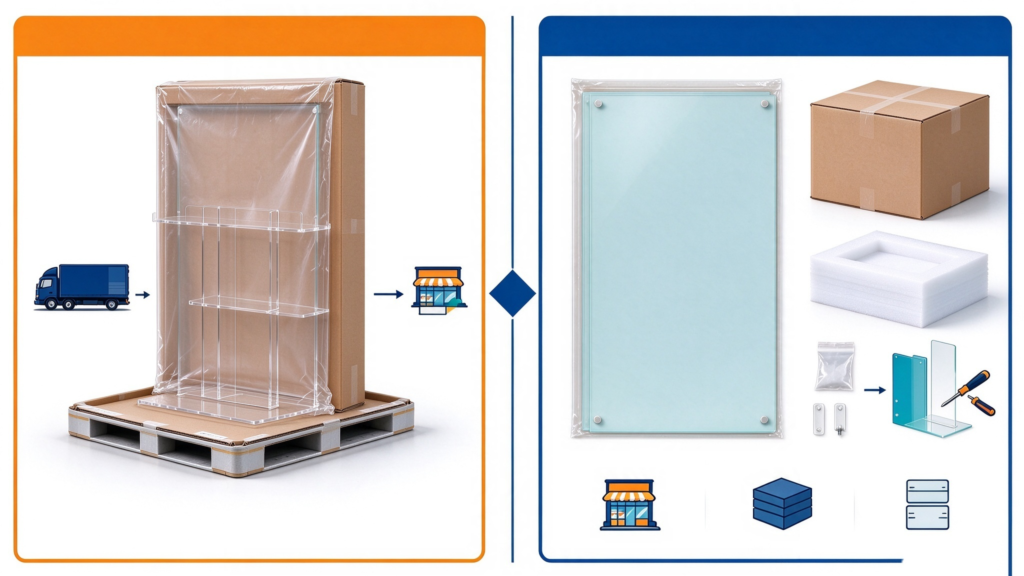
When ordering custom acrylic displays from an overseas factory, buyers need to decide how the products should be delivered. Should the displays arrive fully assembled and ready to use, or should they be packed flat for assembly at the destination?
The choice between flat-pack vs assembled acrylic displays can affect shipping volume, packaging design, product protection, labor costs, and the retail setup process.
Neither option is best for every project. The right choice depends on the display structure, order quantity, destination, and how the products will be installed or distributed.
What Is a Flat-Pack Acrylic Display?
A flat-pack acrylic display is supplied in separate or partially assembled components that are arranged efficiently for transportation. The buyer or another party completes the assembly after delivery.
Depending on the design, a flat-pack display may include separate shelves, side panels, dividers, connectors, or other components.
This approach can be useful when a display has a structure that can be safely assembled at the destination without compromising its appearance or function.
Potential advantages include:
More efficient use of shipping space for suitable designs.
Easier storage of flat components before assembly.
Reduced need to transport certain bulky structures in their final assembled form.
Convenient distribution to multiple retail locations when components are packaged consistently.
However, flat-pack packaging does not automatically guarantee lower shipping costs. The actual result depends on the product dimensions, packaging volume, shipment arrangement, and transportation pricing.
What Is an Assembled Acrylic Display?
An assembled acrylic display arrives with its main structure already put together at the factory. Depending on the product, the buyer may only need to remove the protective packaging and place the display on the counter or shelf.
This option can be attractive to retailers who want a straightforward setup process.
Potential advantages include:
Less assembly work for store employees.
Fewer opportunities for incorrect assembly.
A consistent factory-assembled structure.
Convenient deployment when many stores need to set up displays quickly.
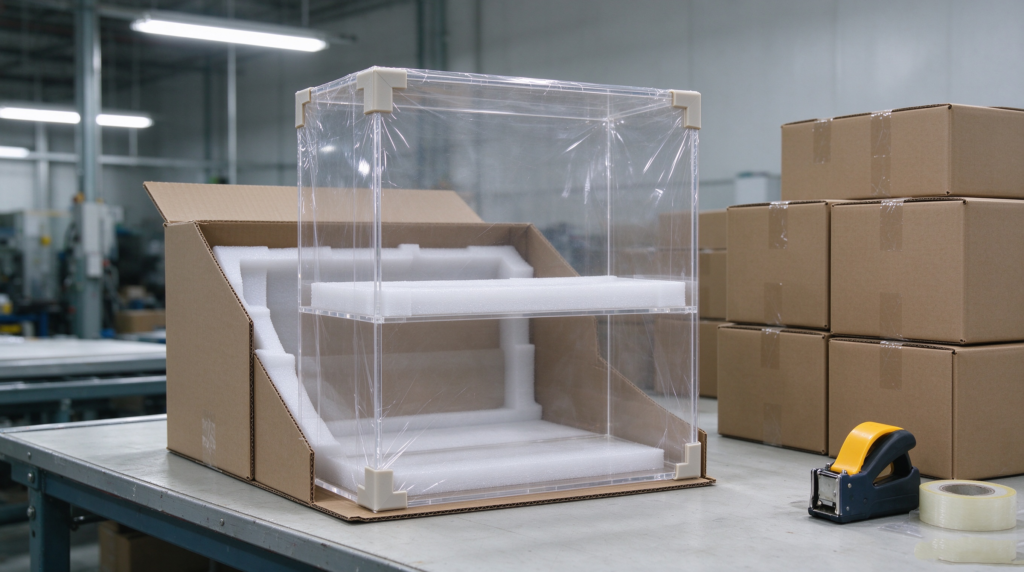
The main consideration is that assembled displays may occupy more shipping and storage space. They may also require packaging that protects the completed structure, including shelves, joints, corners, and decorative surfaces.
Flat-Pack vs. Assembled Acrylic Displays: Key Differences
| Factor | Flat-pack displays | Assembled displays |
|---|---|---|
| Shipping volume | May be lower for suitable designs | May be higher because the product retains its finished shape |
| On-site labor | Requires assembly | Usually requires less assembly |
| Packaging design | Must protect individual components and accessories | Must protect the complete structure and vulnerable joints |
| Storage | Flat components may be easier to store | Finished displays may need more storage space |
| Assembly risk | Depends on design and instructions | Lower for products that arrive ready to use |
| Product suitability | Works best when components can be assembled reliably | Works well when the structure benefits from factory assembly |
| Retail setup | Requires time and suitable workspace | Often faster to deploy |
The best choice should be based on the complete delivery process, not just the carton size or the initial product price.
When Should Buyers Choose Flat-Pack Displays?
Flat-pack delivery may be worth considering when the display design can be divided into components without creating unnecessary assembly difficulties.
1. When Shipping Volume Is a Major Concern
If a fully assembled display has a large footprint, separating suitable components may reduce the space needed for transportation.
This can be especially relevant for products with broad side panels, shelves, or other components that can be arranged flat.
Ask the factory to compare the packed dimensions of both options. A smaller product package does not always translate into lower freight costs, so compare the actual shipping quotations where possible.
2. When Products Must Be Distributed to Multiple Stores
Retail chains and distributors may need to send displays to several locations. Flat-pack components can be convenient when they are packaged and labeled consistently for each destination.
However, the assembly process should be practical for the people receiving the products. If store employees need specialist tools or extensive instructions, the apparent shipping advantage may create additional work later.
3. When the Design Supports Simple Assembly
Flat-pack delivery is most practical when the display can be assembled reliably using a clear sequence and manageable number of components.
Before approving the design, check whether the structure can be assembled without damaging polished edges, printed graphics, or other finished surfaces.
A sample assembly is a useful way to identify problems before a larger order is produced.
When Should Buyers Choose Assembled Displays?
Fully assembled delivery may be more appropriate when convenience, structural complexity, or presentation consistency is a priority.
1. When Store Staff Need a Quick Setup
If displays will be installed across many retail locations, assembly time can become a significant operational consideration.
A factory-assembled display may reduce the time needed at each store, particularly when employees have limited space or experience assembling retail fixtures.
2. When the Structure Is Difficult to Assemble
Some custom displays have multiple shelves, bonded joints, specialized holders, or detailed decorative elements.
If assembly requires careful alignment or specialized handling, completing the work at the factory may be more practical.
The manufacturer should evaluate whether the assembled structure can be shipped safely and whether the required packaging is proportionate to the product’s value and dimensions.
3. When Presentation Consistency Matters
For branded displays, the alignment of shelves, printed logos, and decorative components can affect the final appearance.
Factory assembly allows the supplier to check the finished structure before packing. This does not eliminate every possible shipping issue, but it can reduce the amount of assembly work left to the buyer.
How to Compare the Total Cost of Both Options
A common mistake is to compare only the factory quotation or the shipping cost.
The more useful comparison is the total cost of getting a display ready for use.
Consider the following expenses:
Product manufacturing and assembly.
Packaging materials and packing labor.
Shipping charges based on the actual shipment arrangement.
Warehousing and storage requirements.
Assembly labor at the destination.
Tools or accessories required for assembly.
The cost of correcting assembly errors or handling damaged components.
For example, a flat-pack display might reduce transportation volume but require extra labor at every retail location. An assembled display might cost more to ship but save time during installation.
Which option is more economical depends on the project’s real numbers.
Ask your acrylic factory to quote or estimate both arrangements when the design permits. Compare the packed dimensions, assembly requirements, and expected destination labor before making a decision.
How Packaging Requirements Change With the Delivery Method
The two options require different packaging strategies.
Flat-pack packaging
The factory should consider:
Separating panels to prevent surface-to-surface abrasion.
Protecting corners and polished edges.
Keeping small connectors and accessories organized.
Labeling components where necessary.
Preventing flat panels from shifting or bending under pressure.
Providing assembly instructions if the design requires them.
Assembled-display packaging
The factory should consider:
Protecting exposed corners and edges.
Supporting the structure without putting excessive pressure on shelves.
Preventing movement inside the carton.
Protecting printed logos and decorative finishes.
Ensuring that packaging materials can be removed without damaging the display.
Checking whether the carton can withstand the intended handling and stacking conditions.
In both cases, the packaging should be developed around the product’s structure and the expected transportation conditions.
Questions to Ask Your Acrylic Display Manufacturer
Before approving the production plan, discuss the following points with your supplier:
Can this design be shipped flat without affecting its stability or appearance?
What will the packed dimensions be for each delivery option?
How many components will buyers need to assemble?
Will assembly require tools, adhesive, or specialized skills?
Can the factory provide an assembly sample or instructions?
How will finished surfaces and vulnerable joints be protected?
What are the estimated shipping and destination assembly costs for each option?
These questions help both parties compare practical outcomes instead of choosing a delivery method based on assumptions.

How MORICH Can Help With Custom Acrylic Display Projects
At MORICH, custom acrylic display projects can be developed around the buyer’s product dimensions, retail requirements, structure, and branding needs.
When discussing a new project, buyers can explain whether the display will be installed by store staff, distributed across multiple locations, or delivered directly to the retail counter. Sharing the destination and shipping requirements also helps the team evaluate suitable delivery and packaging arrangements.
Depending on the design, the project can be assessed for flat-pack, partially assembled, or fully assembled delivery.
Explore our custom acrylic display products and manufacturing capabilities, or contact MORICH to discuss your project.
Frequently Asked Questions
Are flat-pack acrylic displays always cheaper to ship?
No. Flat-pack designs may reduce shipping volume, but the final cost depends on the packed dimensions, shipment method, packaging requirements, and freight pricing.
Are assembled acrylic displays safer during transportation?
Not necessarily. An assembled structure may reduce destination assembly work, but it may also expose shelves, joints, and protruding components to transportation stresses. Appropriate packaging is essential for either option.
Can every acrylic display be designed for flat-pack delivery?
No. Some structures are better suited to factory assembly. The manufacturer needs to evaluate the design, connections, required appearance, and intended use before recommending flat-pack delivery.
Should buyers request an assembly sample?
For designs that require destination assembly, a sample can help verify the assembly sequence, fit, appearance, and practicality before production proceeds.
Which delivery method is best for international retail projects?
Choose the method that offers the best balance of shipping cost, product protection, installation labor, and presentation consistency. If the project permits, compare both options using actual packed dimensions and realistic destination costs.
Final Thoughts
Choosing between flat-pack vs assembled acrylic displays is a decision about the entire supply chain, not just how a product fits into a carton.
Flat-pack delivery may offer storage and transportation advantages for suitable designs. Fully assembled delivery may reduce installation work and simplify retail deployment. The right solution depends on the product, destination, and operational requirements.
Discussing these factors with your acrylic display manufacturer early can help you choose a delivery method that works for both your budget and your retail team.