
Custom Domino Quality Control: What Buyers Should Check
When developing custom domino sets, attractive designs are only part of the product requirements. Consistent dimensions, clear numbers, smooth edges, and reliable decoration all contribute to the final user experience.
For retailers, gift brands, and tabletop game businesses, custom domino quality control should begin during sample development rather than after mass production.
Whether you are ordering acrylic dominoes for a new retail collection or developing a personalized gift set, here are the key details worth checking.
1. Check Tile Dimensions and Thickness
Domino tiles should have consistent dimensions throughout the set. Differences in length, width, or thickness can affect the appearance, handling experience, and storage arrangement.
During sample inspection, buyers should check:
Tile length and width.
Material thickness.
Shape and corner consistency.
Uniformity across multiple pieces.
If you have specific dimensional requirements, include them in the product drawing or specification sheet before sampling.
2. Inspect Surface Clarity and Appearance
For transparent acrylic dominoes, surface quality is particularly important.
Look for visible scratches, dust marks, bubbles, cloudy areas, or other imperfections. For colored acrylic, check whether the color is consistent across the set.
Different finishes may create different visual effects:
Clear acrylic for a transparent appearance.
Frosted acrylic for a softer finish.
Solid colors for a bold design.
Patterned acrylic for decorative collections.
The sample should be evaluated under normal lighting conditions to see how the finished product actually looks.
3. Check Edge Finishing
Edges are an important part of acrylic domino quality because the tiles are frequently picked up and handled.
For suitable acrylic designs, diamond edge polishing can create smooth and glossy edges.
During inspection, check for:
Rough or sharp edges.
Uneven polishing.
Visible cutting marks.
Inconsistent edge transparency.
Chipped or damaged corners.
A good edge finish improves both the visual appearance and handling experience.
4. Inspect Dot Placement and Visibility
The dots are the most important functional details of a domino tile. They need to be easy to recognize and consistently positioned.
For printed or engraved dots, buyers should check:
Correct dot patterns and numbers.
Consistent positioning.
Clear contrast against the tile background.
Clean printing or engraving edges.
No missing or visibly damaged details.
UV printing and laser engraving can be considered for different design requirements. The final method should be confirmed through sampling.
5. Compare Colors and Branding Details
Custom domino sets often use specific brand colors or decorative graphics.
If color matching is important, buyers should provide reference images or color specifications. They should also compare the approved sample with the final production pieces.
For branded products, inspect the logo size, position, alignment, and overall appearance.
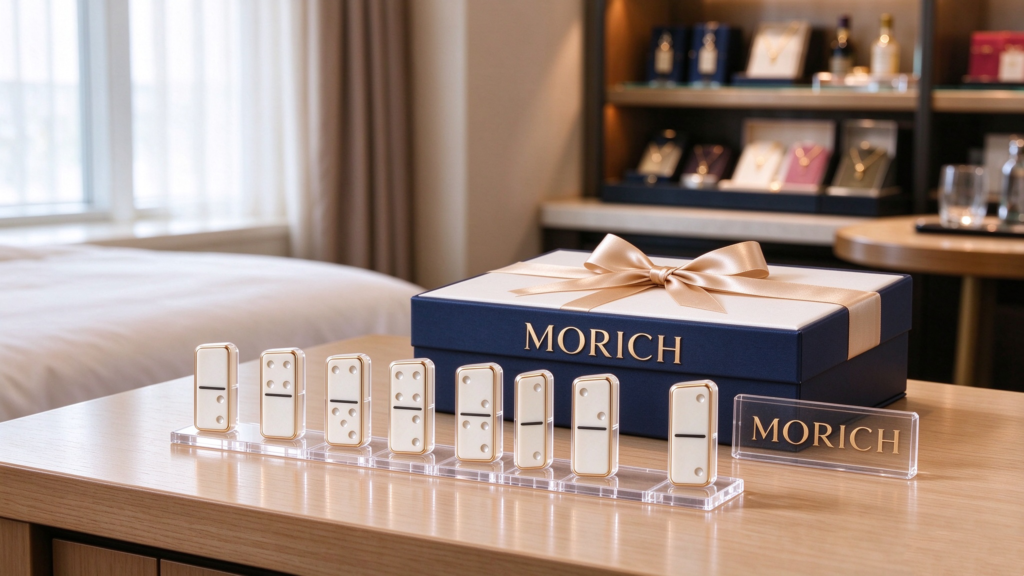
Consistent branding across the tiles and storage box helps create a more professional product collection.
6. Test the Storage Box and Packaging
A domino set is a complete product, so its storage and packaging should also be inspected.
Check whether:
All tiles fit inside the storage box.
The inner tray keeps the pieces organized.
The box opens and closes properly.
The packaging protects the acrylic surfaces.
The finished set looks presentable when opened.
Packaging should be evaluated with the actual domino tiles rather than separately from the product.
7. Approve a Sample Before Mass Production
A physical sample gives buyers an opportunity to confirm the product before production begins.
It is useful to prepare a written sample approval checklist covering dimensions, materials, colors, surface finish, dot patterns, logo details, and packaging.
Once the sample is approved, the confirmed specifications should be used as the reference for production inspection.
If any design changes are made afterward, the updated details should be reviewed and approved again.
MORICH: Supporting Custom Acrylic Domino Development
At MORICH, custom acrylic product development can involve laser cutting, CNC machining, diamond edge polishing, UV printing, and laser engraving.
These manufacturing processes provide different options for developing acrylic domino tiles and related product components.
For each project, the appropriate processes depend on the design, material, decoration requirements, and expected finish. Sample evaluation helps confirm the actual result before production approval.
If you are developing a customized domino set, MORICH can discuss your tile specifications, colors, branding details, and packaging concept.
Explore our acrylic products and manufacturing capabilities, or contact MORICH to discuss your custom acrylic project.
Frequently Asked Questions
Why is sample approval important for custom domino sets?
Sample approval allows buyers to check the actual dimensions, surface appearance, decoration, and packaging before mass production.
How can buyers check acrylic domino quality?
Inspect tile consistency, surface clarity, edge finishing, dot visibility, color matching, and storage box fit.
Can UV printing be used for custom domino dots?
Yes. UV printing can be considered for dots, logos, and decorative graphics on suitable acrylic surfaces. The printing result should be confirmed through a physical sample.
Should every tile have the same dimensions?
Yes. Consistent dimensions help create a uniform appearance and make the set easier to organize and store.
Can MORICH help develop customized acrylic dominoes?
MORICH can discuss acrylic material options, processing methods, decoration, and related packaging requirements for custom product projects.