
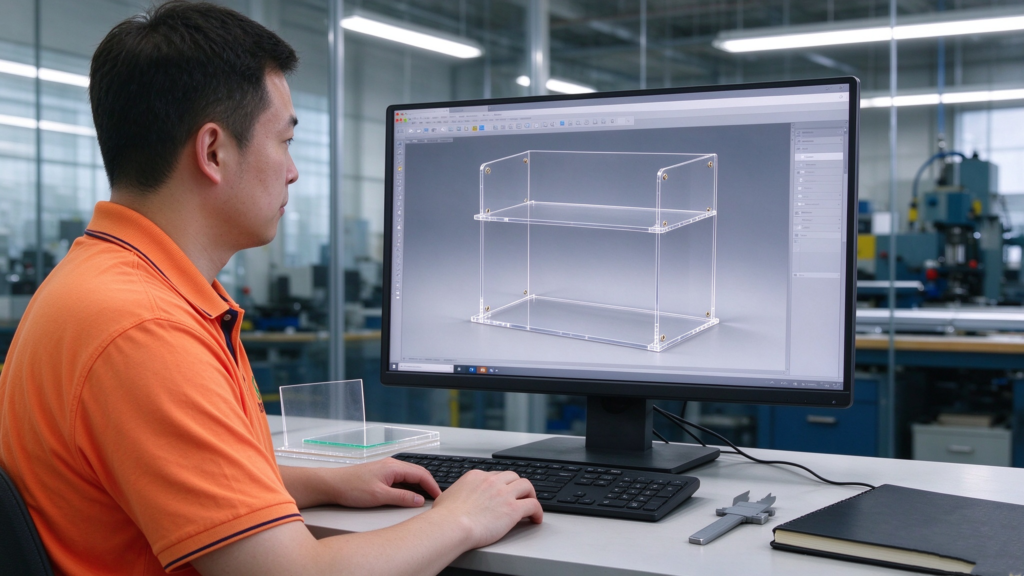
Why Acrylic Display Prototyping Matters
A custom display can look perfect in a drawing and still have problems when the first physical unit is produced.
The product may not fit correctly. The base may not be stable. A logo may appear too large. The display may also look different from what you expected.
This is why Acrylic Display Prototyping is an important step before mass production.
A physical prototype allows buyers and manufacturers to evaluate the actual product, make adjustments and confirm the design before committing to a larger production quantity.
Rapid prototyping is widely used to turn digital designs into physical parts and validate concepts before final production.
1. Check Whether the Product Fits Correctly
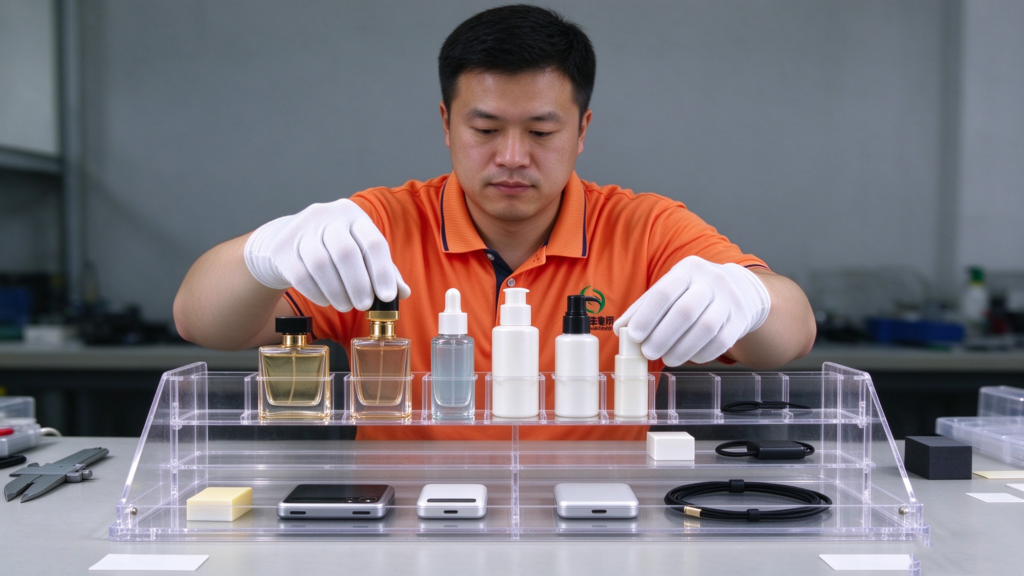
One of the biggest advantages of Acrylic Display Prototyping is that you can test the actual product fit.
A display may need to hold:
- Cosmetic bottles
- Jewelry
- Collectibles
- Electronic products
- Retail packaging
- Promotional products
Small dimensional differences can affect how easily products are inserted, removed and positioned.
A prototype lets you physically place your product into the display instead of relying only on a drawing.
This is particularly important for custom holders, slots, compartments and multi-level displays.
2. Verify the Display Structure
A display needs to do more than look good.
It also needs to stand properly and support the intended products.
During prototyping, buyers can check:
- Overall stability
- Base dimensions
- Product support
- Shelf spacing
- Connection points
- Component alignment
- Ease of assembly
If something feels too weak, too large or difficult to assemble, the design can be modified before mass production.
This can prevent a relatively small design issue from becoming a much larger production problem.
3. See the Real Acrylic Appearance
Digital renderings are useful, but they cannot completely replace a physical sample.
A prototype allows you to evaluate the actual:
- Acrylic clarity
- Edge appearance
- Surface finish
- Color
- Thickness
- Transparency
- Printing quality
- Overall proportions
This is especially useful when the display is highly visible in a retail environment.
For example, a brand may initially select a particular acrylic color on screen but discover that another color or finish looks better when combined with its products and lighting.
4. Test Your Branding Before Mass Production
Branding is another reason to use Acrylic Display Prototyping.
A custom display may include a logo, product name, graphics or other visual elements.
During sampling, you can check:
- Logo position
- Logo size
- Print quality
- Color matching
- Text readability
- Graphic proportions
This gives the buyer an opportunity to make changes before hundreds or thousands of displays are produced.
Different acrylic fabrication and decoration processes can also affect the final appearance. ACRYLITE’s fabrication resources cover processes including laser machining, routing, printing and other acrylic fabrication methods.
5. Find Design Problems Before Mass Production
A prototype is not only a sample to approve.
It is also a testing tool.
For example, you may discover that:
The product is difficult to remove from the display.
Or:
The display occupies too much counter space.
Or:
The logo is hidden when the product is placed on the shelf.
These problems are much easier to solve during the prototype stage.
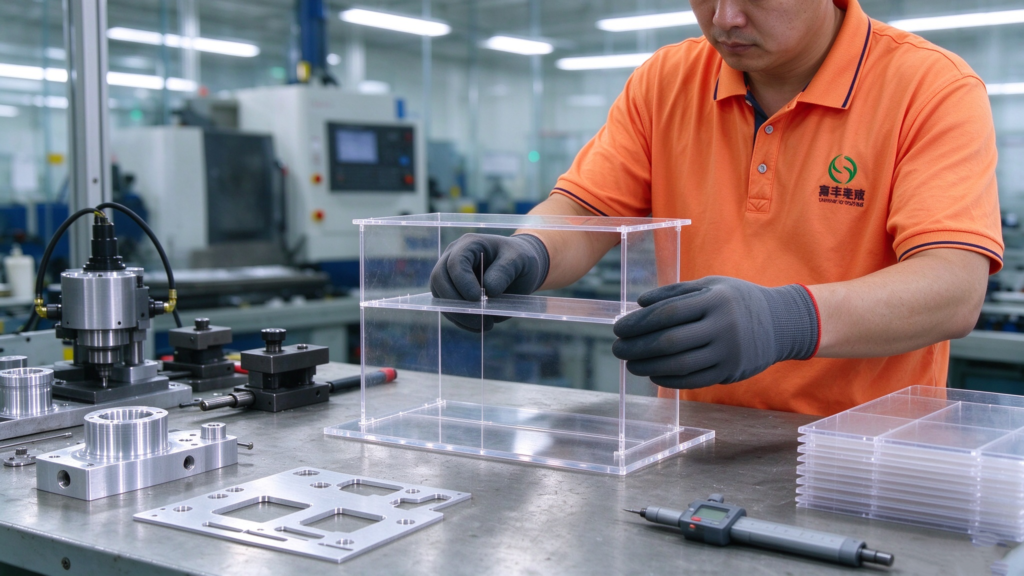
Acrylic can be processed using methods such as laser cutting and CNC routing, allowing manufacturers to create different components and adjust the design before production is finalized.
6. Reduce the Risk of a Large Production Mistake
The purpose of Acrylic Display Prototyping is not necessarily to make production more complicated.
It is to reduce uncertainty before mass production.
Imagine ordering 1,000 displays and discovering after delivery that the product holder is too narrow.
Changing the entire production order at that stage can be expensive and time-consuming.
A prototype gives both the buyer and manufacturer a physical reference before the production quantity becomes large.
This is especially valuable for:
- New display designs
- New products
- Complex structures
- Customized branding
- Large-volume orders
- International B2B projects
When Should You Request an Acrylic Display Prototype?
A prototype is particularly useful when your display has a new or customized structure.
You should strongly consider sampling when:
- The display has never been manufactured before
- Product dimensions are critical
- Several acrylic components need to fit together
- Your logo or graphics are important
- The display will be produced in large quantities
- The display needs to be assembled at the destination
- The design will be used for an important retail launch
For a simple, standardized product, sampling requirements may be different.
The appropriate approach depends on the design, quantity and application.
What Should You Check on the Prototype?
When your sample arrives, do not only look at whether it looks attractive.
Use a simple inspection checklist.
Product Fit
Place the actual products into the display.
Check whether they fit securely and whether customers can easily remove them.
Dimensions
Measure the important dimensions and compare them with your approved drawing.
Stability
Place the display on the intended surface and test whether it remains stable during normal use.
Appearance
Check acrylic clarity, edges, color, finish and overall proportions.
Branding
Check logo position, size, printing quality and color.
Assembly
If the display requires assembly, test the complete assembly process.
Packaging
If the prototype includes production-style packaging, check whether the components are adequately protected during transportation.
How MORICH Approaches Acrylic Display Prototyping
MORICH supports custom acrylic display projects from design development through sampling and mass production.
The website’s manufacturing process includes 3D structural design and rapid prototyping, with sample turnaround listed at 3–5 days for applicable projects.
The production capabilities include processes such as laser cutting, CNC machining and diamond polishing, allowing different acrylic components to be developed and refined according to the project requirements.
For a new project, buyers can provide:
- Product dimensions
- Product photos
- Reference designs
- CAD drawings
- Logo files
- Estimated quantity
- Target application
MORICH can then evaluate the design requirements and move toward prototype development before mass production.
Prototype First, Production Second
A good custom acrylic display should not be judged only by a computer rendering.
The real question is whether the finished display works with the actual product, fits the intended space, represents the brand correctly and can be manufactured consistently.
That is why Acrylic Display Prototyping can be a valuable step for B2B buyers.
A physical sample gives both sides an opportunity to identify problems, improve the design and confirm the details before moving into larger production.
For buyers developing a new custom acrylic display, a prototype is often a small step that can help reduce much larger risks later.
FAQ About Acrylic Display Prototyping
What is acrylic display prototyping?
Acrylic display prototyping is the process of producing a physical sample of a custom acrylic display before mass production.
Is a prototype necessary for every acrylic display?
No. The need for a prototype depends on the design complexity, quantity, product fit and application. New or complex custom displays generally benefit more from sampling.
What can I test with an acrylic display prototype?
You can check product fit, dimensions, stability, appearance, branding, assembly and overall functionality.
How long does an acrylic display prototype take?
The timing depends on the design and manufacturing requirements. MORICH currently states a 3–5 day rapid sample turnaround for applicable projects.
Can I change the design after receiving the prototype?
Yes. One of the main purposes of prototyping is to identify improvements before mass production begins.