
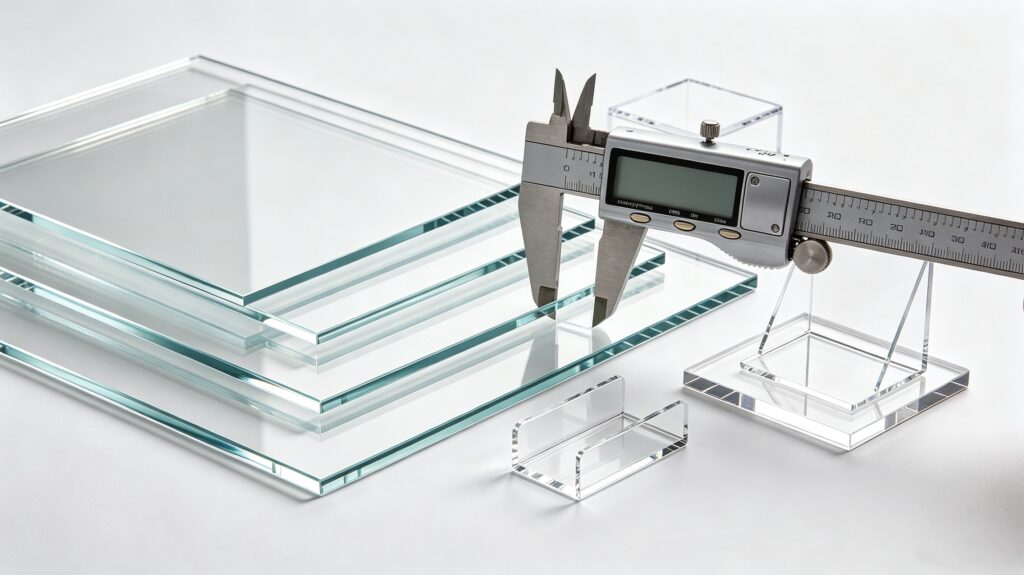
Choosing the right acrylic thickness for display stands is important for both appearance and structural performance. If the acrylic is too thin, a display may bend or become unstable. If it is unnecessarily thick, the product can become heavier and more expensive.
The ideal thickness depends on several factors, including the display size, product weight, structure, processing method, and intended application.
For this reason, professional acrylic manufacturers normally select the material thickness according to the complete display design rather than using one thickness for every project.
1. Consider the Weight of the Products
Product weight is one of the first factors to consider when selecting acrylic thickness.
Lightweight products such as:
- Jewelry
- Keychains
- Small cosmetics
- Cards
- Small accessories
may require less material than heavier products such as:
- Perfume bottles
- Glass containers
- Electronics
- Large cosmetic packaging
- Multiple-product displays
The heavier the product load, the more important it becomes to consider acrylic thickness, support points, bending, and the overall structure.
2. Consider the Size of the Display Stand
The larger the acrylic panel, the more important thickness becomes.
A small countertop display may use relatively thin acrylic because the unsupported span is short. A large display with wide panels may require thicker material or additional structural support.
For example, a large back panel, long shelf, or wide acrylic platform may need a different solution from a small product holder.
Therefore, acrylic thickness for display stands should always be evaluated together with panel dimensions.
3. Common Acrylic Thickness Options
Different projects may require different acrylic thicknesses.
| Acrylic Thickness | Typical Applications |
|---|---|
| 2–3 mm | Lightweight inserts, small holders |
| 3–5 mm | Small countertop displays |
| 5–8 mm | Larger countertop and retail displays |
| 8–10 mm | Heavy-duty structures |
| 10 mm+ | Large or highly structural displays |
These ranges are general guidelines rather than fixed rules. The actual thickness should be determined by the display structure, dimensions, product load, and manufacturing method.
For technical information about acrylic sheet properties and applications, manufacturers such as PLEXIGLAS® provide detailed material resources. PLEXIGLAS® technical information
4. Think About the Display Structure
Thickness is only one part of the structural design.
A 3 mm acrylic panel with properly designed supports may perform better than a thicker panel with a poorly designed structure.
When developing a custom display, manufacturers may consider:
- Support points
- Bending angles
- Slots and joints
- Panel size
- Product positioning
- Base structure
- Reinforcement components
For example, a multi-tier acrylic display may require different thicknesses for the shelves, back panel, and supporting components.
5. Consider the Product Type
Different industries have different display requirements.
Cosmetics
Perfume bottles, skincare containers, and makeup products often require stable shelves and product-specific compartments.
Jewelry
Jewelry is lightweight, so visual clarity and precise product positioning may be more important than heavy structural support.
Electronics
Electronic products can be heavier and may require stronger shelves or reinforced structures.
Retail Gifts
Small gift products often use compact countertop displays, tiered stands, or individual product holders.
This is why there is no single acrylic thickness for display stands that works for every application.
6. Don’t Choose Thickness Based Only on Price
It can be tempting to choose thinner acrylic to reduce material costs. However, saving material does not always mean reducing the total project cost.
An unsuitable thickness may lead to:
- Bending
- Instability
- Cracking
- Poor appearance
- Product damage
- Redesign costs
On the other hand, using unnecessarily thick acrylic can increase material consumption, weight, shipping costs, and processing requirements.
A professional manufacturer should balance strength, appearance, cost, and manufacturing efficiency.
7. Let the Factory Evaluate Your Actual Products
For customized displays, the best approach is to provide the factory with actual product information.
Customers can send:
- Product dimensions
- Product weight
- Cosmetic bottles
- Lipstick boxes
- Perfume bottles
- Packaging samples
- Drawings
- Reference images
MORICH can evaluate the product requirements and develop the display structure accordingly.
The process can include:
Product Evaluation → Concept Design → Structural Design → Factory Drawing → Prototype → Sample Approval → Mass Production
For more information about custom solutions, visit MORICH’s custom acrylic display products.
Acrylic Thickness for Display Stands: A Simple Selection Guide
If you need a quick starting point:
Small and lightweight products: Consider 2–3 mm.
Standard countertop displays: Consider 3–5 mm.
Larger retail displays: Consider 5–8 mm.
Heavy products or large structures: Consider 8–10 mm or thicker.
However, these are starting points, not universal specifications. The final acrylic thickness for display stands should be confirmed based on the actual design and product load.
Frequently Asked Questions
What is the best acrylic thickness for a display stand?
There is no single best thickness. The appropriate thickness depends on product weight, display dimensions, structure, and application.
Is thicker acrylic always stronger?
Not necessarily. Structural design, support points, panel dimensions, and processing methods also affect the performance of an acrylic display.
What acrylic thickness is suitable for cosmetics displays?
Small cosmetics displays may use 3–5 mm acrylic, while larger displays or displays carrying heavier perfume bottles may require thicker material or additional structural support.
Can MORICH recommend the acrylic thickness for my project?
Yes. Provide your product dimensions, weight, drawings, or physical samples, and MORICH can evaluate the structure and recommend a suitable material thickness.
Can different acrylic thicknesses be used in one display?
Yes. A custom display may use different thicknesses for shelves, supports, back panels, bases, and product holders depending on the structural requirements.
Get the Right Acrylic Display Thickness
Selecting the correct acrylic thickness for display stands is a balance between strength, appearance, product safety, cost, and manufacturing requirements.
Instead of choosing thickness based only on a standard chart, working with an experienced acrylic manufacturer can help you develop a display around your actual products and retail environment.
MORICH provides custom acrylic display design, engineering, prototyping, OEM/ODM manufacturing, quality inspection, packaging, and global delivery.
Send us your product dimensions, drawings, photos, or physical samples to start your custom acrylic display project.