
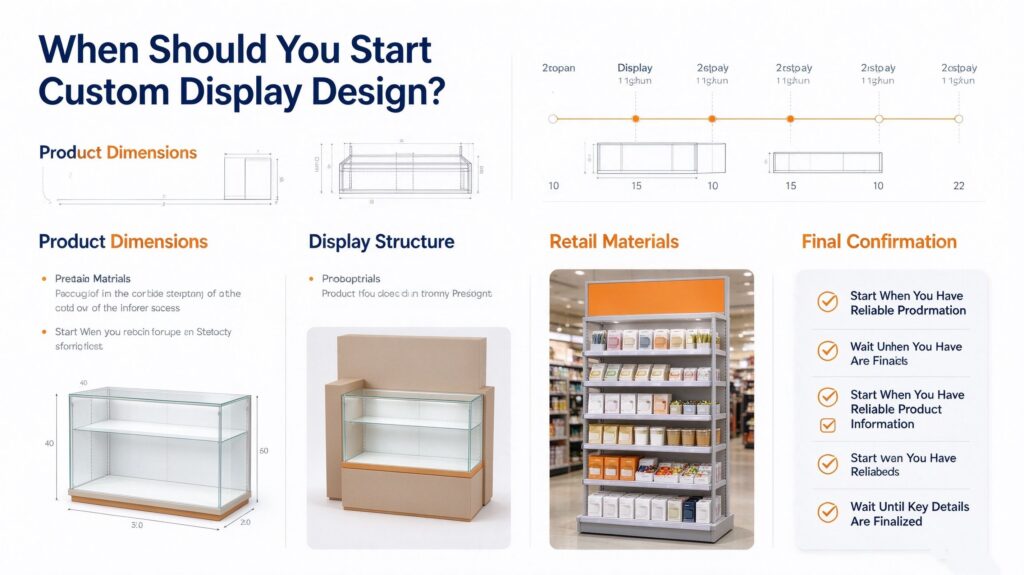
You are preparing to launch a new product. The packaging is almost ready, the marketing team is planning the launch, and your retail customers have started asking about product displays.
There is just one problem: the product dimensions may still change.
Should you start designing the display now, or wait until everything is finalized?
Starting too early can lead to redesigns, incorrect compartments, and displays that no longer fit the product. Waiting too long can leave you rushing to prepare retail materials before launch.
The best approach is to start custom display design when you have enough reliable product information to develop the structure, while identifying which details still need confirmation.
Here is how to make that decision.
1. Separate Confirmed Details From Pending Changes
Not every product detail needs to be finalized before display development can begin.
The important thing is knowing which information is reliable and which information may still change.
For example, your product’s overall shape may already be confirmed, while the retail packaging is still being revised. You may be able to develop the general display concept now, but the exact compartment dimensions should wait until the packaging is stable.
Before contacting a display manufacturer, divide your information into three groups:
-
Confirmed: Product dimensions, packaging design, or other details that will not change.
-
Pending confirmation: Specifications that are still being reviewed internally.
-
Optional: Decorative features or design preferences that can be adjusted later.
This simple step helps the manufacturer understand which parts of the display can be developed immediately and which parts should remain flexible.
It also reduces the risk of treating preliminary information as a final production specification.
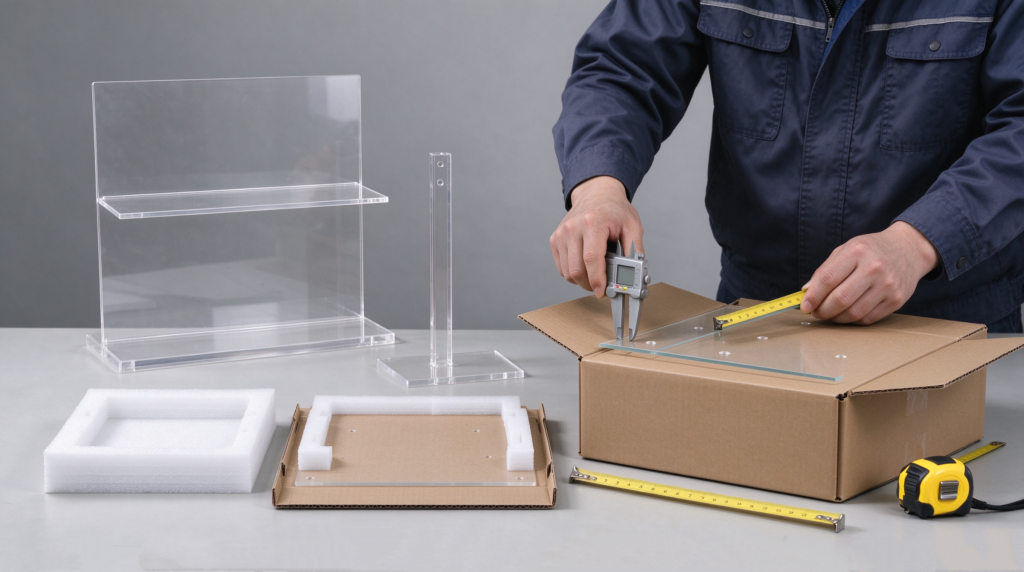
2. Confirm the Dimensions That Affect Product Fit
A product display can look excellent in a rendering and still fail in practice if the actual product does not fit.
This is especially important when the display contains custom-cut slots, individual compartments, shaped supports, or tightly arranged products.
Before finalizing the structure, confirm:
-
Product length, width, and height.
-
Dimensions of the retail packaging, if the packaged product will be displayed.
-
The space needed to insert and remove each item.
-
The number of products to be displayed at one time.
-
Any protruding parts, handles, caps, or irregular shapes.
For products with several sizes, provide the complete range rather than measurements for only one item.
If the product dimensions are still changing, ask the manufacturer to develop the overall concept first and postpone the final fit-dependent details.
A useful rule: Do not approve production dimensions based on measurements that your product team still considers temporary.
3. Decide Whether the Display Holds the Product or Its Packaging
This may sound obvious, but it is a common source of design confusion.
A display designed for an unboxed product can have very different compartment dimensions from one designed to hold the retail package.
Imagine a skincare brand launching a bottle in a new carton. The bottle itself may remain unchanged, but the carton becomes taller and wider after the branding team updates the packaging.
If the display was designed around the bottle, the cartons may not fit. If the display was designed around the carton, the bottles may need different support or positioning.
Before design begins, clarify the intended presentation:
-
Will customers see the product outside its packaging?
-
Will the product remain inside its retail box?
-
Will the display show both the product and its packaging?
-
Must the display accommodate multiple packaging versions?
If your product packaging is still being finalized, tell the display manufacturer. This detail can affect the entire layout.
4. Use a Reference Sample When Drawings Are Not Ready
You do not always need a complete engineering drawing to start a display project.
If you already have a physical product sample, your manufacturer may be able to use it to understand the dimensions, shape, weight, and presentation requirements.
Useful reference materials include:
-
Photos of the product from different angles.
-
Basic measurements.
-
A physical product sample, when practical.
-
Existing packaging or packaging prototypes.
-
Photos of displays you like.
-
A rough sketch showing how the products should be arranged.
These materials help communicate your requirements before the final design is complete.
However, reference photos and physical samples are not always enough for production approval. Critical dimensions, tolerances, and branding details should still be documented and confirmed before manufacturing.
If the product is still in development, make sure the manufacturer knows whether the sample represents the final version.
5. Avoid Finalizing Branding Before the Layout Is Settled
Display branding is another area where premature approval can create unnecessary work.
The logo may be ready, but its final position depends on the display structure. A logo placed on the front panel of an early concept may overlap a shelf, become partially hidden by the products, or look unbalanced after the display dimensions change.
Before approving artwork, check:
-
The final position and size of the logo.
-
Whether products will cover any printed information.
-
The available space for graphics and product names.
-
The relationship between brand colors and the display material.
-
Whether the artwork needs to be updated after structural changes.
You can prepare the logo files and brand guidelines early. Final placement should be reviewed against the approved display design.
For inspiration, see our article on Acrylic Logo Effects. Confirm the published URL before adding the link.
6. Know Which Changes Are Easy and Which Are Expensive
Not every design revision has the same impact.
Changing a logo position before printing begins may be relatively straightforward. Changing the width of a compartment after the acrylic panels have been cut may require new components and additional labor.
The actual impact depends on the production stage and the nature of the change.
| Type of change | Potential impact |
|---|---|
| Updating artwork before printing | Artwork revision and approval |
| Changing a panel dimension before cutting | Drawing and production-program revision |
| Changing compartment sizes after parts are made | Possible replacement components |
| Changing the overall structure after sample approval | Additional design and sample work |
| Changing specifications during mass production | Possible delays, rework, or material waste |
These are general examples, not fixed rules for every project.
The best way to reduce unnecessary revisions is to identify the decisions that must be finalized before each production milestone.
Ask your manufacturer to explain which changes are still possible and which could affect cost or schedule.
7. Work Backward From Your Product Launch Date
Display design should be coordinated with the product launch, not treated as a separate task that begins after the product is finished.
If your display must arrive before a trade show, retail launch, or promotional campaign, work backward from the date the displays need to be ready.
Allow time for:
-
Internal product and packaging confirmation.
-
Initial design and drawing review.
-
Sample development, if required.
-
Sample evaluation and revisions.
-
Final specification and artwork approval.
-
Mass production, inspection, and delivery.
The actual duration depends on design complexity, material availability, order quantity, and shipping arrangements.
You do not need to wait until every marketing detail is finished to contact a manufacturer. Early communication can help identify technical questions while your product team is still making decisions.
What you should avoid is committing to final production before the critical product and display specifications are approved.
A Practical Timeline for Your Next Display Project
Here is a simple way to coordinate product development and display design.
Stage 1: Concept development
Share product photos, preliminary dimensions, the intended display location, and your target launch date. Discuss the general structure and possible design directions.
Stage 2: Product confirmation
Confirm the product and packaging dimensions that determine the display’s fit. Update the manufacturer if the product changes.
Stage 3: Design approval
Review the display dimensions, product layout, branding, materials, and assembly requirements. Resolve important questions before approving the design.
Stage 4: Sample review
If a sample is required, test it with the actual product or packaging. Check fit, appearance, accessibility, and stability.
Stage 5: Production approval
Confirm the final specifications and artwork. Make sure both parties are working from the same approved version before mass production begins.
This staged approach helps your team make progress early without treating unfinished product information as final.
How MORICH Supports Custom Display Design
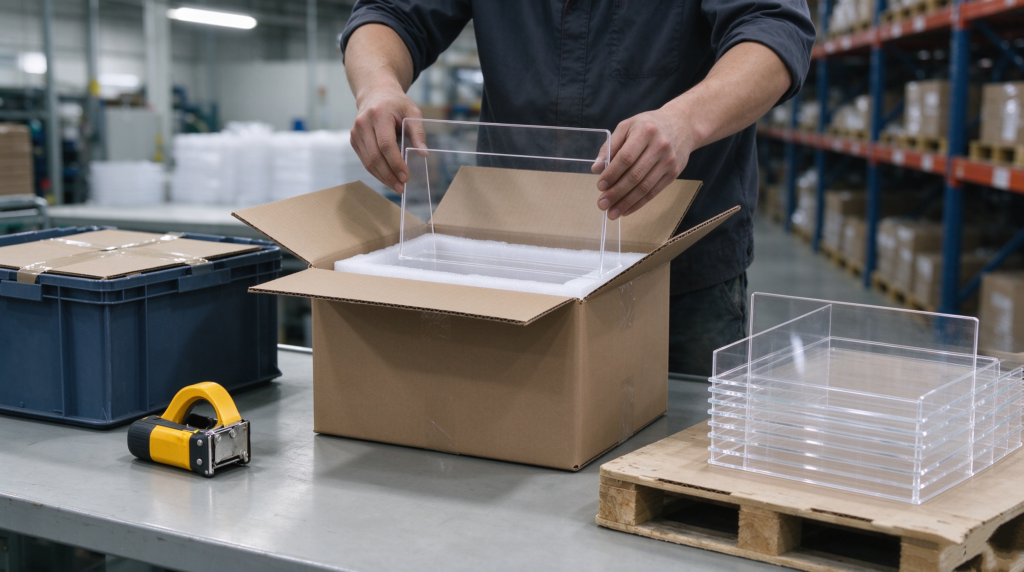
MORICH develops finished custom acrylic displays for businesses that need displays tailored to their products, branding, and retail applications.
Depending on the project, our capabilities include design coordination, CNC machining, laser cutting, edge polishing, printing, and assembly.
You can begin a discussion even if your product drawings are not complete. Share the information you already have, identify the details that may change, and explain how the display will be used.
The team can then review the requirements and discuss the appropriate next steps for your project.
Explore our custom acrylic commercial displays or learn more about our manufacturing capabilities. Please verify the live URLs before publishing.
Frequently Asked Questions
Should I finish my product packaging before designing a display?
Not necessarily. You can start discussing the display concept earlier, but the final compartment dimensions should be based on confirmed product or packaging measurements, depending on what the display will hold.
Can a manufacturer design a display without a technical drawing?
Often, yes. Product photos, measurements, reference images, and physical samples can help communicate the requirements. The manufacturer may then develop drawings for review before production.
What happens if my product dimensions change after the display design is approved?
The manufacturer will need to assess the change. Depending on the affected components and production stage, it may require revised drawings, replacement parts, additional costs, or schedule adjustments.
When should I approve the display artwork?
Prepare your logo and brand guidelines early, but approve the final artwork after the display layout and relevant panel dimensions have been confirmed.
Do I need a sample before mass production?
A sample is useful when fit, appearance, assembly, or other important details need physical verification. Whether it is necessary depends on the complexity of the design and the risks associated with getting it wrong.
Final Thoughts
You do not have to wait until every detail of a new product is complete before starting a display project. However, you do need to distinguish between information that is ready for design and specifications that still require confirmation.
Start the conversation early, confirm the dimensions that affect product fit, and approve the final structure only when the essential details are reliable.
This approach helps your team coordinate product development and custom display design without rushing into avoidable redesigns.
Developing a new product or preparing for a retail launch? Share your product photos, available dimensions, packaging status, and target launch date with MORICH to discuss the next steps.