
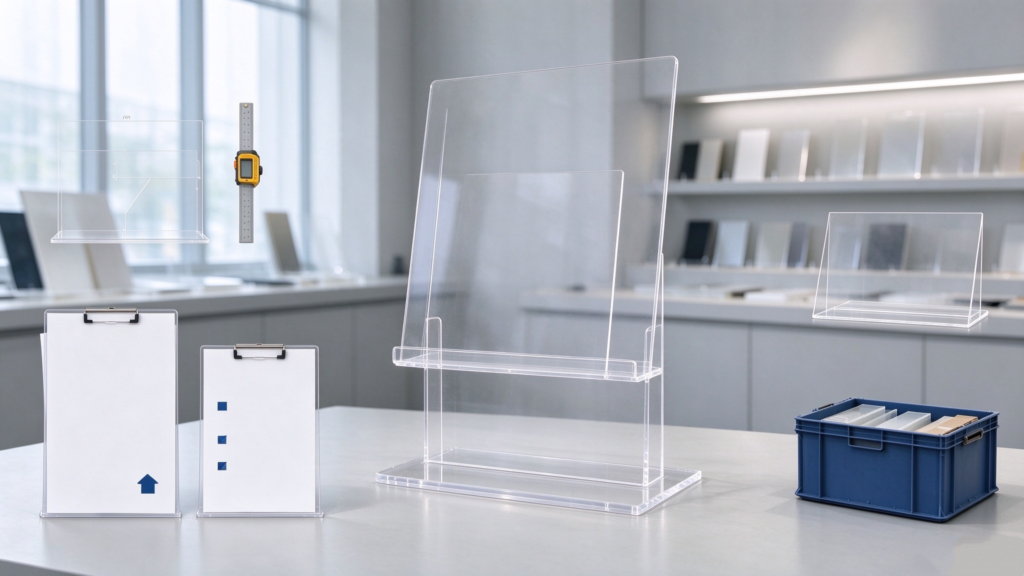
You have sent your product requirements to several display manufacturers and received three quotations. One is surprisingly cheap, another is much more expensive, and the third includes details that the others do not mention.
Which one offers the best deal?
Before choosing a supplier, you need to understand what each custom display quote actually covers. A low quoted price does not always mean a lower final cost. Some suppliers include packaging and assembly, while others charge for them separately. Shipping, sample development, artwork preparation, and other expenses may also affect your budget.
For buyers sourcing custom acrylic displays from overseas manufacturers, comparing quotations line by line can help prevent unexpected costs and misunderstandings.
Here is what to look for before placing your order.

1. Product Specifications and Materials
The first thing to check is whether the supplier is quoting for the exact display you requested.
A quotation should identify the main product specifications clearly enough for you to understand what you are buying.
Depending on the project, these details may include:
Overall length, width, and height.
Acrylic type, thickness, color, and finish.
Number of shelves, compartments, or components.
Printing, engraving, or other decorative features.
Assembly requirements and included accessories.
Any agreed tolerances or special requirements.
For example, two suppliers may quote for a clear acrylic cosmetics display of the same overall dimensions. However, one may specify thicker panels, additional dividers, and printed branding, while the other quotes for a simpler structure.
These are not necessarily equivalent products.
What to ask: “Can you confirm that your quotation covers the specifications in our latest drawing and reference images?”
If you have multiple drawings or revisions, identify the correct version before comparing prices.
2. Design and Sample Development Costs
Some custom display projects require additional work before production can begin.
This may include reviewing your concept, preparing production drawings, developing a sample, or adjusting the design to fit your products.
However, suppliers do not all handle these costs in the same way. Some include basic design coordination in the product price, while others charge separately for engineering work or sample development.
Your quotation should clarify the applicable arrangements.
| Cost item | What to confirm |
|---|---|
| Design support | Is basic design coordination included? |
| Technical drawings | Are detailed production drawings charged separately? |
| Sample production | What is the sample fee? |
| Sample modifications | Are revisions included or charged separately? |
| Sample shipping | Is delivery of the sample included? |
Do not assume that paying for a sample means the sample fee will automatically be deducted from your bulk order. Ask the supplier to confirm its policy in writing.
If your design is still being developed, it is particularly important to distinguish between the cost of getting the design ready and the cost of manufacturing the finished displays.
3. Printing, Logos, and Other Custom Features
Branding can make a significant difference to the final price of a custom display.
A quotation for an unprinted acrylic stand may not be comparable to one that includes a full-color logo, multiple printed panels, or decorative finishing.
Depending on your design, additional costs may relate to:
UV printing and full-color graphics.
Laser engraving.
Silk-screen printing.
Special acrylic colors or finishes.
Additional components or decorative details.
Artwork preparation or revisions.
For example, a simple logo on one front panel may require a different production process from full-color graphics across several surfaces.
Send your logo in a suitable file format and specify its position, dimensions, and colors. If you have a reference image showing the desired effect, include that too.
Ask the supplier to confirm which branding elements are included in the quoted price. This helps prevent a situation where you approve the product price only to discover that your intended logo treatment costs extra.
4. Production, Assembly, and Quality Control
A custom display quotation should make it clear what happens between the start of production and delivery of the finished product.
Depending on the design, manufacturing may involve cutting, CNC machining, edge polishing, printing, bonding, assembly, and inspection.
Not every quotation lists each production operation separately. Some suppliers provide a single finished-product price. That is acceptable as long as the scope is clear.
Pay particular attention to assembly. A display shipped as separate components may cost less than one that is fully assembled, but it could require additional labor at your warehouse or retail locations.
You should also clarify the expected quality requirements.
For example:
Are dimensions checked against the approved drawing?
Is the printing inspected for alignment and appearance?
Are visible surfaces checked for scratches or defects?
Are the displays inspected after assembly?
What process applies if the products do not meet the agreed specifications?
Do not assume that a quotation automatically includes a particular inspection standard. Ask the manufacturer to confirm the inspection scope and acceptance criteria before production.
5. Packaging and Shipping Preparation
Packaging is one of the cost items buyers should check carefully, particularly when importing acrylic displays from China.
Acrylic surfaces can be scratched, and complex structures may be damaged if components move during transportation. Packaging requirements therefore need to match the product design and shipping method.
A quotation may include basic protective packaging, but additional requirements could cost extra.
Confirm whether the price covers:
Protective film or surface protection.
Individual bags or protective wrapping.
Foam, inserts, or other cushioning materials.
Individual product boxes or retail-ready packaging.
Master cartons and export packaging.
Special packing requirements for fragile or complex products.
If you need each display individually packed for direct distribution to retail stores, say so before the supplier prepares the quotation.
Also clarify whether the quotation includes freight. Product packaging and international transportation are separate cost categories, even when one supplier arranges both.
For more guidance, see our article on Acrylic Display Packaging.
6. Shipping Terms, Freight, and Import Charges
A product quotation is not necessarily a delivered-to-your-door price.
When buying from an overseas manufacturer, check the delivery term stated in the quotation. EXW, FOB, and DAP can involve different responsibilities, costs, and risk-transfer points.
| Delivery term | What buyers should understand |
|---|---|
| EXW | The seller makes the goods available at the agreed location. The buyer generally takes on most transport arrangements and costs from that point. |
| FOB | For applicable sea or inland-waterway shipments, the seller delivers the goods on board the nominated vessel at the agreed port. The buyer generally arranges the main sea freight. |
| DAP | The seller arranges delivery to the named destination, ready for unloading. Import clearance and import duties are generally the buyer’s responsibility. |
| DDP | The seller takes responsibility for delivery and import clearance, including applicable import duties and taxes, subject to the agreed terms and its ability to perform those obligations. |
These terms have specific rules, so confirm the named place or port and the applicable version of the Incoterms rules in the contract.
Other charges to clarify may include:
International freight.
Cargo insurance, if required.
Export documentation.
Customs clearance.
Import duties and taxes.
Destination handling and delivery charges.
If one supplier quotes EXW and another quotes DAP, their totals cannot be compared directly without accounting for the different delivery scopes.
Buyer tip: Ask for the product price and shipping costs to be shown separately whenever practical. This makes it easier to compare suppliers and evaluate different shipping options.
7. Payment Terms, Lead Time, and Quote Validity
The quotation should explain the commercial terms that apply if you decide to place the order.
Check the following details before approving it.
Payment terms
Confirm the deposit, balance payment schedule, accepted payment method, and any conditions for releasing the goods. Do not assume that every manufacturer uses the same payment arrangement.
Production lead time
Ask when the production schedule starts. It may begin after deposit receipt, drawing approval, sample approval, or another agreed milestone.
Clarify whether the estimated lead time includes sample development, mass production, and shipping. These stages should not be confused.
Quote validity
Material prices, freight rates, and other costs may change. Check how long the quotation remains valid and whether any charges can change after that period.
Order quantity
Confirm the quantity covered by the price. If you are considering a larger order, request pricing for several quantities so you can understand how the unit price changes.
These details may not alter the product’s appearance, but they can significantly affect your purchasing decision and project budget.

How to Compare Custom Display Quotes Fairly
Once you receive several quotations, avoid comparing only the final unit price.
Create a simple comparison using the same specifications and quantity for every supplier.
| Comparison item | Supplier A | Supplier B | Supplier C |
|---|---|---|---|
| Product specifications | Confirm | Confirm | Confirm |
| Branding included | Confirm | Confirm | Confirm |
| Sample costs | Confirm | Confirm | Confirm |
| Assembly included | Confirm | Confirm | Confirm |
| Packaging included | Confirm | Confirm | Confirm |
| Shipping term | Confirm | Confirm | Confirm |
| Production lead time | Confirm | Confirm | Confirm |
| Payment terms | Confirm | Confirm | Confirm |
| Quote validity | Confirm | Confirm | Confirm |
Fill in the actual information from each supplier rather than relying on assumptions.
You may discover that the lowest-priced supplier excludes services you need, while a slightly higher quotation includes them. Alternatively, you may find that a more expensive quotation includes features your project does not require.
The best quotation is the one that meets your specifications and commercial requirements at an acceptable total cost.
For a closer look at the factors that influence pricing, read Custom Acrylic Display Quotes: 7 Key Cost Factors.
What Information Should You Send to Get an Accurate Quote?
The quality of a quotation depends partly on the information you provide.
If the supplier receives only a product photo and the message “Please quote,” it may need to make assumptions about dimensions, materials, branding, and packaging.
Those assumptions can lead to price differences or later revisions.
For a more accurate quotation, provide:
Product dimensions, weight, and photos.
A drawing or reference image of the desired display.
Acrylic thickness, color, and finish preferences, if known.
Logo files and printing requirements.
Estimated order quantity.
Packaging requirements.
Delivery destination and preferred shipping term.
Target delivery date, if applicable.
You do not need to know every technical detail before making an inquiry. If some specifications are undecided, tell the supplier which items are confirmed and which are still open for discussion.
This helps the manufacturer distinguish between a preliminary estimate and a quotation based on finalized requirements.
How MORICH Approaches Custom Display Projects
MORICH manufactures finished custom acrylic displays for businesses that need product-specific dimensions, structures, and branding.
Depending on the project, our manufacturing processes may include design coordination, CNC machining, laser cutting, edge polishing, printing, and assembly.
When requesting a quotation, share your product information, reference images, estimated quantity, and intended application. If you have a target budget, communicating it can also help the team explore suitable design options.
The exact quotation scope depends on the individual project. Before placing an order, confirm the specifications, included services, payment terms, packaging, delivery arrangements, and any additional charges in writing.
You can explore our custom acrylic commercial displays or learn more about our manufacturing capabilities.
Frequently Asked Questions
Does a custom display quote include shipping?
Not necessarily. Some quotations cover manufacturing only, while others include shipping under a specified delivery term. Confirm the named destination, shipping costs, and which party is responsible for import clearance and duties.
Are design and sample fees included in the product price?
It depends on the supplier and project. Ask whether design support, sample production, revisions, and sample shipping are charged separately. Request written confirmation of any sample-fee credit policy.
Why do two suppliers quote different prices for the same display?
The quotations may differ in material specifications, printing, assembly, packaging, quality requirements, or delivery terms. Ask both suppliers to quote against the same drawing, quantity, and requirements before comparing their prices.
Can a manufacturer change the price after I approve the quotation?
The answer depends on the agreed terms and whether the specifications or circumstances change. Confirm the quotation’s validity, the conditions for price adjustments, and the final approved specifications in writing before placing the order.
What is the difference between a product price and a delivered price?
A product price may cover only manufacturing. A delivered price depends on the agreed shipping term and may include transportation to a specified destination. Import duties, taxes, and unloading may still be excluded, depending on the terms.
Final Thoughts
A custom display quote should give you a clear understanding of what you are buying, what you will pay, and which responsibilities remain with you.
Before choosing a supplier, check the product specifications, design and sample costs, branding, assembly, packaging, shipping terms, payment conditions, and quotation validity.
The goal is not simply to find the lowest number. It is to understand the full scope of the order so you can make a purchasing decision with fewer surprises.
Requesting a custom acrylic display quotation? Send MORICH your product photos, dimensions, design references, estimated quantity, and delivery destination to start the discussion.