
Custom acrylic display quotes can vary significantly, even when two suppliers appear to offer similar products. One manufacturer may quote a lower price, while another may include different materials, finishing details, packaging, or customization services.
For purchasing managers, brand owners, and distributors, understanding these differences is essential before choosing a supplier. The cheapest quotation is not always the most cost-effective option, especially when the display must meet specific branding, durability, and retail presentation requirements.
In this guide, we explain seven factors that influence custom acrylic display quotes and show you how to compare offers more accurately.
1. Acrylic Material, Thickness, and Color
Material selection is one of the first factors that affects the cost of a custom acrylic display.
Acrylic displays can use different thicknesses, colors, and finishes depending on their intended application. A small display for lightweight cosmetics may have different material requirements from a larger stand designed to hold heavier products.
Common considerations include:
Acrylic thickness: Thicker panels may be needed for larger structures or heavier products.
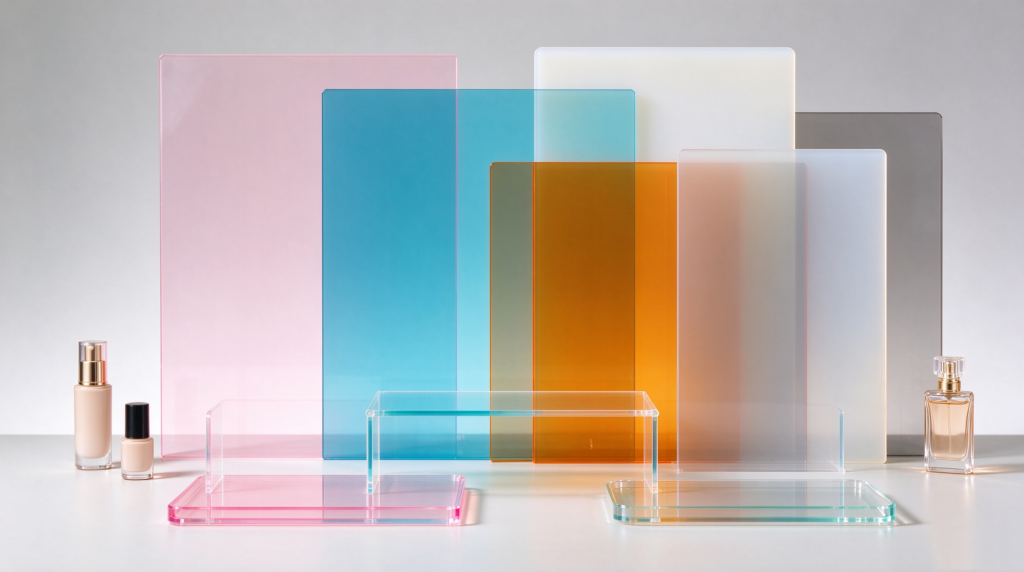
Acrylic color: Clear, white, black, and custom-colored acrylic can create different visual effects and cost structures.
Surface finish: Transparent, frosted, and other finishes may require different material choices or additional processing.
Material utilization: The dimensions and layout of the parts affect how efficiently the material can be used.
Choosing the thickest material available is not necessarily the best approach. Excessive thickness can add cost and weight without providing a meaningful benefit for some designs.
Instead, discuss the product’s weight, display dimensions, and intended use with your manufacturer. The goal is to select material specifications that provide suitable strength, appearance, and cost efficiency.
For more guidance, see our article on Acrylic Thickness for Display Stands.
2. Display Size and Structural Complexity
The overall size of a display affects its material consumption, but size alone does not determine the price.
Two displays with similar dimensions can have very different production requirements.
For example, a simple rectangular riser may require relatively few parts, while a multi-tier cosmetics display could include several shelves, product compartments, a branded header, and multiple assembled components.
Structural complexity can increase costs through:
More individual parts to manufacture
Additional cutting and machining operations
More complicated assembly
Tighter fitting requirements
Additional inspection and adjustment
A design with many small compartments or precise product slots may require more processing and quality checks than a straightforward stand.
When requesting a quotation, provide reference images, approximate dimensions, product measurements, and the number of items the display needs to hold.
If you have not finalized the design, explain your functional requirements first. A manufacturer may be able to suggest a simpler structure that preserves the intended appearance while reducing unnecessary production steps.
3. Cutting, Edge Polishing, and Finishing Processes
The production process also influences custom acrylic display quotes.
Depending on the design, acrylic parts may require laser cutting, CNC machining, edge polishing, drilling, bending, or other operations.
Each process serves a different purpose.
Laser cutting: Suitable for many acrylic shapes and detailed cutouts.
CNC machining: Useful for certain precision features and structural requirements.
Diamond edge polishing: Creates smooth, glossy edges on suitable acrylic parts.
Drilling and assembly preparation: Supports the connection and installation of different components.
A display with many polished edges may require more finishing work than one with fewer visible edges. Similarly, complex cutouts and multiple assembly points can add processing time.
However, more processes do not automatically mean better quality. The appropriate combination depends on the design, the required appearance, and how the display will be used.
When comparing quotes, ask whether the quoted finish matches your expectations. If edge clarity, surface appearance, or dimensional accuracy matters to your brand, communicate these requirements before production.
4. Logo Printing and Custom Branding
Branding is another important factor in custom acrylic display quotes.
A display may use a simple one-color logo, a full-color graphic, multiple printed areas, or a more subtle engraved effect. These choices affect both appearance and production requirements.
Common options include:
UV printing: Suitable for many colorful graphics, logos, and promotional designs.
Silk screen printing: Useful for certain designs, colors, and repeat-production requirements.
Laser engraving: Can create a frosted or engraved effect on suitable acrylic surfaces.
The final cost may depend on the logo size, number of printing positions, artwork complexity, number of colors, and quantity of displays.
For example, a small logo printed in one position may require less work than a display featuring full-color graphics on several panels.
To help your supplier quote accurately, provide your logo artwork, preferred colors, approximate logo dimensions, and placement requirements. If you are unsure which process is suitable, share a reference image showing the effect you want.
You can also explore our guide to Acrylic Logo Effects to understand the available branding options.
5. Order Quantity and Production Efficiency
Order quantity can significantly affect the unit price of a custom acrylic display.
Manufacturing involves more than the cost of raw materials. Depending on the project, preparation, setup, printing, inspection, and assembly may also contribute to the total cost.
When these activities are spread across a larger order, the cost per unit may decrease.
However, the relationship between quantity and price is not identical for every project. A simple design and a complex, highly customized display may respond differently to changes in order volume.
If you are planning a new product launch, consider asking for quotations at several quantities, such as:
Sample or prototype quantity
Initial production quantity
Expected repeat-order quantity
This allows you to compare the pricing structure and understand how order volume affects your purchasing budget.
If you need a sample before mass production, ask whether the sample fee is separate from the bulk order and whether any credit or adjustment is available for a subsequent order.
Most importantly, confirm the specifications before approving mass production. A lower unit price offers little value if the finished displays do not fit your products or meet your branding requirements.
6. Packaging and Shipping Requirements
A quotation should reflect how the displays will be packed and delivered, not just how much it costs to manufacture them.
Acrylic displays can be vulnerable to scratches and damage during handling and transportation. Packaging requirements depend on the product’s shape, size, structure, finish, and shipping method.
Potential cost factors include:
Protective films and surface protection
Individual bags or protective wrapping
Foam, inserts, or other cushioning materials
Inner boxes and outer cartons
Custom retail packaging
Carton dimensions and shipment volume
A compact display with a simple structure may be easier to pack than a large display with projecting components or multiple delicate parts.
The shipping destination and delivery terms also matter. A quotation based on EXW is not directly comparable to one that includes transportation under DAP terms. The services and costs included in each offer need to be checked carefully.
When requesting a quote, specify the destination country, delivery address or warehouse requirements where available, preferred packaging, and applicable delivery terms.
This helps you evaluate the overall purchasing cost rather than focusing only on the factory unit price.
7. Tooling, Sampling, and Project-Specific Charges
Some custom projects involve additional charges for design development, sampling, or specialized production requirements. Whether these apply depends on the product and manufacturing method.
For many custom acrylic displays, production can use processes such as laser cutting, CNC machining, polishing, printing, and assembly without requiring a dedicated mould.
At MORICH, many acrylic display designs can be developed without dedicated moulds. This can help avoid unnecessary upfront mould costs for suitable projects. However, the best production approach depends on the product’s structure, specifications, and required finish.
Before approving a quotation, clarify the following:
Is the sample fee quoted separately?
Does the price include design or structural development?
Are there any one-time project-specific charges?
Are any charges repeated with each order?
What specifications and services are included in the quoted price?
A detailed quotation makes it easier to understand what you are paying for and reduces the risk of unexpected costs later.
For a closer look at sample development, read our article on Acrylic Display Prototyping.

How to Compare Custom Acrylic Display Quotes
When you receive quotations from different suppliers, avoid comparing unit prices alone. First, confirm that the offers are based on equivalent requirements.
Review these key points:
Materials: Are the acrylic specifications, colors, and thicknesses comparable?
Dimensions: Are the overall size and internal product spaces the same?
Structure: Does each quotation cover the same number of shelves, compartments, and components?
Finishing: Are cutting, polishing, and assembly requirements clearly defined?
Branding: Are the logo method, artwork, colors, and placement consistent?
Quantity: Are all suppliers quoting for the same order volume?
Packaging and shipping: Do the quotations include comparable packaging and delivery terms?
It is also useful to confirm the estimated production lead time, sample approval process, payment terms, and quotation validity.
If one supplier offers a substantially lower price, ask which specifications or services differ. The difference may reflect a simpler design, different packaging, fewer finishing operations, or exclusions from the quotation.
The purpose is not simply to find the lowest number. It is to identify the supplier offering the best fit for your quality requirements, budget, and delivery schedule.
How MORICH Helps Buyers Develop Cost-Effective Acrylic Displays
MORICH supports custom acrylic display projects through design development, sampling, cutting, machining, edge polishing, logo customization, and assembly, depending on project requirements.
We understand that buyers need to balance product appearance, manufacturing cost, and practical retail use.
If you are developing a new display, you can begin by sharing:
Photos of the products to be displayed
Reference images or an existing display sample
Approximate display dimensions
Product weight and the number of items to hold
Logo artwork and preferred visual effects
Estimated order quantity
Packaging and shipping destination
You do not necessarily need a complete technical drawing to start a discussion. These details can help establish the initial requirements and identify which design decisions need to be confirmed.
For projects where a dedicated mould is unnecessary, a suitable mould-free production approach may also help control upfront costs.
Contact MORICH to discuss your project and request a quotation based on your specific requirements.
Frequently Asked Questions
Why are custom acrylic display quotes so different?
Quotes may differ because of material thickness, dimensions, structural complexity, finishing, logo customization, order quantity, packaging, shipping, and project-specific charges. Always compare the specifications included in each offer.
Does a thicker acrylic display always cost more?
Thicker acrylic generally uses more material, but the total quotation also depends on the design, dimensions, processing, finishing, and quantity. The best thickness should match the display’s functional and visual requirements.
Can I reduce the cost without sacrificing appearance?
Potentially, yes. You can discuss simplifying the structure, optimizing dimensions, reducing unnecessary components, choosing appropriate finishes, and reviewing packaging requirements with your manufacturer. Any changes should preserve the display’s essential functions and quality expectations.
Do custom acrylic displays always require moulds?
No. Many acrylic displays can be manufactured through cutting, machining, polishing, printing, and assembly without dedicated moulds. Whether a mould is needed depends on the design and production method.
Should I compare sample prices or bulk prices first?
Both matter, but they serve different purposes. Sample pricing helps you evaluate the design and product fit, while bulk pricing helps you assess the production budget. Confirm how the sample will be approved and how mass production will follow the agreed specifications.
Final Thoughts
Custom acrylic display quotes reflect much more than the amount of acrylic used. Materials, structural design, finishing, branding, order quantity, packaging, and shipping can all influence the final price.
Before choosing a supplier, make sure you understand what each quotation includes. Clear specifications and a consistent comparison process can help you avoid unexpected charges and choose a solution that balances cost, appearance, and practical performance.
Planning a custom acrylic display project? Share your product photos, design references, estimated quantity, and branding requirements with MORICH to start discussing a suitable solution.