
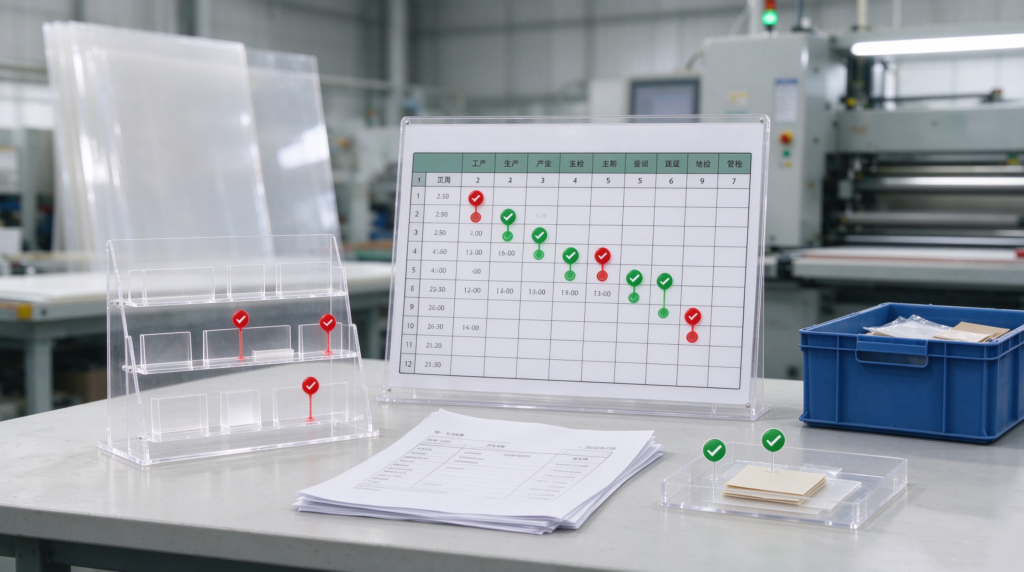
Acrylic display lead time is an important consideration for retailers, brand owners, distributors, and purchasing managers planning a new product launch or retail promotion.
Even when a manufacturer can produce a high-quality display, unclear specifications, delayed artwork approval, repeated design changes, or incomplete shipping information can push the delivery date back.
For buyers, a delayed display can mean missed promotional opportunities, empty retail spaces, or additional coordination costs.
The good news is that many avoidable delays can be reduced through better preparation and communication. In this guide, we explain seven practical ways to manage your custom acrylic display project and keep production moving.

What Is Acrylic Display Lead Time?
Acrylic display lead time refers to the time required to complete the relevant stages of a custom display order. Depending on the supplier’s quotation and project arrangement, it may cover design confirmation, sampling, material preparation, manufacturing, quality inspection, and packing.
Shipping time is often calculated separately, so buyers should confirm exactly what the quoted lead time includes.
For example, a quotation may refer only to factory production time, while the buyer also needs to allow time for sample approval and international transportation.
The actual schedule depends on the display’s complexity, order quantity, material availability, customization requirements, production capacity, and approval process. There is no single lead time that applies to every project.
Before placing an order, ask your manufacturer to explain the main production stages and identify which activities must be completed before the next stage can begin.
1. Prepare Complete Product Information Before Requesting a Quote
One of the easiest ways to prevent delays is to provide the manufacturer with enough information at the beginning.
If the supplier does not understand your product dimensions, display requirements, or intended application, additional questions and design revisions may be needed before production can start.
Prepare the following information where available:
Product photos or reference images
Product dimensions and weight
Approximate display dimensions
Number of products the display must hold
Preferred acrylic color and finish
Logo artwork and branding requirements
Estimated order quantity
Required delivery date and destination
You do not necessarily need a finished technical drawing to begin a discussion. A reference image and a clear description can provide a useful starting point.
However, the manufacturer will need sufficient confirmed specifications before finalizing the design and production plan.
If you are still preparing your project brief, read our guide to How to Request an Acrylic Display Quote.
2. Confirm the Design Before Sampling
Design changes can affect both production time and project cost.
For example, changing shelf heights, adding compartments, moving a logo, or adjusting the overall dimensions may require updated drawings, new calculations, or another sample.
Some changes are minor, while others can affect the entire display structure.
Before approving a design, check the details that matter to the finished product:
Overall dimensions and available retail space
Product fit and compartment sizes
Number and position of shelves
Logo placement and artwork
Acrylic color, thickness, and finishing
Assembly method and stability
If several people are involved in approving the project, collect their feedback before sending a consolidated response to the manufacturer.
This helps reduce conflicting instructions and repeated revisions.
A clearly approved design gives both sides a more reliable basis for planning the next stage.
3. Submit Final Logo Artwork and Printing Requirements Early
Branding is a common source of avoidable delays in custom acrylic display projects.
A manufacturer may be ready to prepare a sample, but production can be held up if the logo file is missing, the artwork is low resolution, the colors are unconfirmed, or the printing position has not been approved.
To keep the project moving, provide your logo artwork and branding requirements as early as possible.
Confirm:
The correct logo file and version
Required logo dimensions
Printing or engraving position
Preferred colors and visual effect
Any supporting text or promotional graphics
Whether the artwork needs to be reviewed before production
Different branding methods may produce different visual results. UV printing, silk screen printing, and laser engraving each have their own characteristics and suitability.
If you are unsure which method to choose, explain the appearance you want and ask the manufacturer to recommend an appropriate process.
You can explore our guide to Acrylic Logo Effects for more information.
4. Approve the Sample Without Unnecessary Delays
For a new or complex display, sampling helps verify the physical product before mass production.
However, the sampling stage can become a bottleneck if feedback is delayed or the approval criteria are unclear.
Before the sample is made, agree on what needs to be checked. This may include dimensions, product fit, surface appearance, logo placement, assembly, and stability.
Once you receive the sample, organize the review promptly.
If adjustments are needed, provide clear feedback with marked-up photographs or specific measurements rather than general comments such as “make it look better.”
For example, instead of saying “the shelf is too small,” specify the required change and explain which product dimension the shelf needs to accommodate.
Also clarify whether the requested change can be made directly or whether it requires another sample.
A faster approval process does not mean skipping quality checks. It means making decisions clearly and avoiding unnecessary rounds of revision.
5. Confirm Material and Order Quantity Before Production
Material availability and order quantity can affect the production schedule.
A standard material may be readily available, while a special color, unusual thickness, or project-specific component may require additional preparation or sourcing.
Likewise, a larger order may require more time for cutting, finishing, printing, assembly, and inspection.
Before confirming the order, discuss the following with your manufacturer:
Whether the required acrylic specifications are available
Whether special materials or colors need additional preparation
Whether the order quantity fits the proposed schedule
Whether the display requires several different components
Whether any outsourced processes affect the timeline
Avoid changing the material, color, or quantity after production has been scheduled unless the change is necessary.
Such revisions can affect material planning and manufacturing arrangements.
If your project has a fixed launch date, communicate that deadline early so the supplier can assess feasibility before confirming the order.
6. Agree on Production Milestones and Responsibilities
A single estimated delivery date may not provide enough visibility for a complex custom display project.
A more useful approach is to agree on the major project milestones.
Depending on the project, these may include:
Design and specification confirmation
Sample production and approval
Material preparation
Mass production
Quality inspection
Packing and shipment preparation
For each milestone, clarify who needs to provide information or approve the next step.
For example, the manufacturer may be responsible for preparing a sample, while the buyer needs to review it and confirm whether production can proceed.
If approval is delayed, the overall schedule may also shift.
Ask the supplier to identify the main dependencies and provide updates when significant milestones are completed.
It is also useful to distinguish between the estimated factory completion date and the expected arrival date. They are not the same, particularly for international orders.
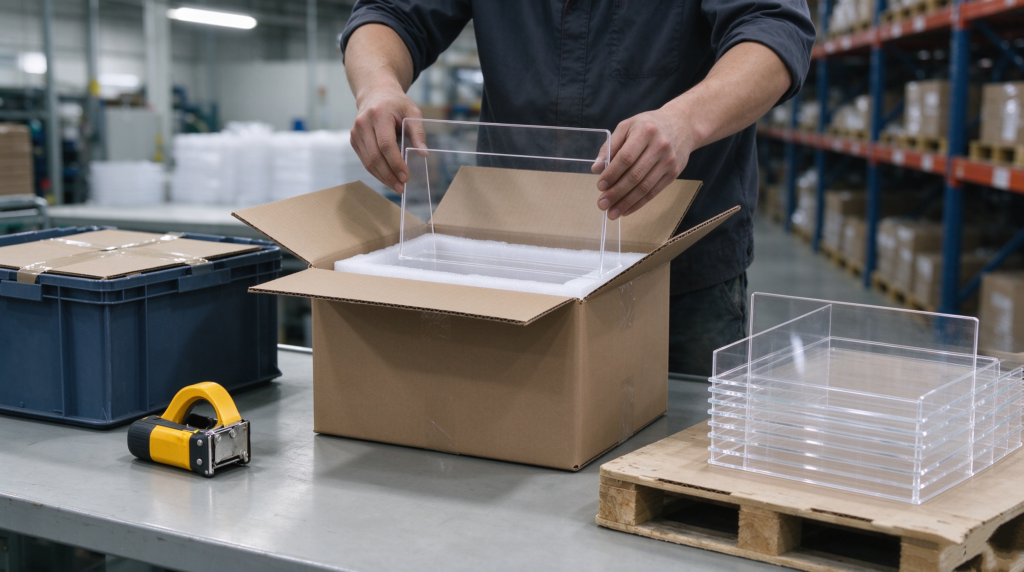
7. Plan Packaging and Shipping Before the Final Production Stage
Packaging and transportation should be discussed before the displays are ready to leave the factory.
Custom acrylic displays may require individual protection, separators, cushioning, inner cartons, or special arrangements for projecting components.
If packaging requirements are not confirmed until the end of production, additional preparation may be necessary.
Provide your manufacturer with the destination, preferred shipping method, packaging requirements, and any warehouse receiving instructions as early as possible.
You should also clarify:
Whether displays will ship assembled or disassembled
How many units will be packed in each carton
Expected carton dimensions and gross weight
Whether special labels are required
Which shipping terms apply
Whether transportation time is included in the estimated schedule
For international orders, allow time for transportation and potential customs or handling procedures. The actual arrival date can depend on factors outside the manufacturer’s direct control.
Our guide to Acrylic Display Packaging explains how packaging decisions can affect the shipment.
How to Plan an Acrylic Display Order for a Fixed Launch Date
If your displays must arrive before a store opening, trade show, or promotional campaign, work backward from the date when the products need to be ready for use.
A simple planning process is:
Step 1: Set the required arrival date. Consider when the displays need to be unpacked, installed, and stocked.
Step 2: Estimate transportation time. Discuss the proposed shipping method and destination with your supplier or logistics provider.
Step 3: Confirm the factory completion target. Ask the manufacturer how much time is needed for production, inspection, and packing.
Step 4: Allow time for design and sample approval. Include time for review and potential revisions where applicable.
Step 5: Confirm the schedule with the manufacturer. Make sure both sides understand the target dates and the information required at each stage.
Avoid treating the earliest possible schedule as a guaranteed delivery date. A realistic plan should reflect the project’s complexity and allow reasonable flexibility for issues that may arise.
How MORICH Supports Custom Acrylic Display Projects
MORICH develops custom finished acrylic displays for retail, branding, and product presentation applications.
Depending on project requirements, our capabilities can include 3D structural design, sample development, CNC machining, laser cutting, diamond edge polishing, logo customization, and assembly.
Because different display designs require different processes, the production schedule should be evaluated according to the actual specifications rather than a universal lead time.
To help assess your project, provide your product photos, dimensions, reference designs, logo artwork, estimated quantity, and required delivery date.
If you have a fixed launch or promotional deadline, mention it at the beginning of the discussion. This gives the team an opportunity to review the requirements and assess whether the proposed schedule is realistic.
For new projects, you can also read our guide to Acrylic Display Prototyping.
Frequently Asked Questions
How long does it take to manufacture custom acrylic displays?
The schedule depends on design complexity, order quantity, material availability, branding requirements, sample approval, and production capacity. Ask your manufacturer to provide a project-specific estimate and clarify whether it includes sampling, packing, and shipping.
What usually causes acrylic display production delays?
Common causes include incomplete specifications, repeated design revisions, late artwork approval, material availability issues, changes in order quantity, and unconfirmed packaging requirements.
Can I skip sampling to save time?
For a simple, well-defined project, the appropriate process may differ from that for a new or complex display. However, skipping sampling can increase the risk of discovering design or fit problems during mass production. Discuss the trade-offs with your manufacturer before deciding.
Is production lead time the same as shipping time?
Not necessarily. Factory lead time generally refers to the time needed for the manufacturing stages included in the quotation. Transportation may be separate. Always confirm the scope of the quoted schedule.
How can I get a more accurate delivery estimate?
Provide complete specifications, confirm the artwork and material requirements, communicate the required arrival date, and ask the manufacturer to identify the major project milestones. A realistic estimate depends on having enough information to assess the actual order.
Final Thoughts
Managing acrylic display lead time starts before manufacturing begins. Clear specifications, timely design approval, finalized artwork, confirmed materials, and early packaging planning can help reduce avoidable delays.
For buyers working toward a product launch or retail deadline, the most important step is to establish a realistic schedule with the manufacturer and understand which decisions could affect it.
Planning a custom acrylic display project? Contact MORICH with your design references, product dimensions, estimated order quantity, and required delivery date to discuss your project and its production schedule.